

Shame is the Most Hidden Mood in Any Workplace — and It Shapes More Than We Realise
Shame is hard to talk about because it doesn't want to be seen. Where resentment leaks sideways and anger announces itself, shame works quietly underneath. This piece goes a layer deeper than my earlier writings on shame, into the distinction between the emotion and mood of shame, and what that mood does to how we see ourselves, our work, and the people around us.

I have written before about how shame forms in a shame and honor culture, and how it shows up in the language and behaviours of the workplace. This one builds on the last two and hopefully goes a layer deeper. It is about what shame does to us as observers, to the very lens through which we see ourselves, our work, and the people around us.
Shame is not just an emotion that comes and goes. It is a way of seeing.
Shame is hard to talk about because it doesn't want to be seen. That is its nature. Where resentment leaks out sideways and anger announces itself, shame works quietly underneath. It bends what we notice, what we say, what we dare to attempt. And by the time we feel its effects, it has usually been at work for a long time.
The Emotion of Shame and the Mood of Shame
This is a distinction worth knowing. The emotion of shame is a moment. Something happens, a public correction or an idea dismissed in front of others, and there is a wave of shame that moves through us. The chest tightens. The face warms. We want to disappear. The wave is uncomfortable, but it passes. The emotion does its work and moves on once the event is over.
The mood of shame is something else entirely. It is shame that has stopped being a visitor and become a resident. It is no longer something we feel. It is something we live in, often without realising it. The walls of our room are made of shame, and we live inside the room long enough that we mistake the walls for the world.
When we are in the mood of shame, we are not having a shame reaction to a specific event. We are already in shame before the event happens. This is a key distinction. A colleague's feedback is read through shame. The boss's silence in the meeting is read through shame. The mistake in a submission is interpreted through shame. There does not need to be a triggering moment, because the mood is already there, doing the interpreting in advance.
In my own life, the mood of shame was largely invisible to me for years. I blamed others for their behaviours. I thought my self-criticism was high standards. It took a breakdown and the slow work of ontological coaching for me to see that I had been living inside a mood, not seeing the world.
The mood of shame is dangerous in workplaces precisely because it is invisible to the one inside it. Emotions are tied to events. Moods are what we live in. And what we live in, we tend not to question.
How the Mood of Shame Looks in Workplaces
The mood of shame at work does not look like sadness or visible distress. It often looks like something else entirely.
Sometimes it looks like the high-performing colleague who cannot rest. Works through every weekend, takes on every extra project. From the outside, dedication. From the inside, the mood whispering if I stop, I will be exposed.
Sometimes it looks like the leader who cannot let anything go. Every detail must pass through them. From the outside, high standards. From the inside, if something fails, the inner voice whispers “I am a failure”.
Sometimes it looks like the team member who caveats every statement with "I'm not sure but…" From the outside, humility. From the inside, the mood negotiating in advance for safety from judgment.
Sometimes it looks like charm. The person everyone likes. From the outside, emotional intelligence. From the inside, the mood keeping itself safe through being liked.
Do these behaviours mean they are 100% expressions of shame? Absolutely not! That is the thing about the mood of shame. The narratives are visible mostly to the people inside the mood, who are doing what the mood asks of them.
Shame as an Observer
In ontological coaching, we talk about the observer - the one who sees, interprets, and acts in the world. Different observers see different worlds. The shame observer sees a particular kind of world.
In the world of the shame observer, every interaction is a verdict. Every silence from a colleague is read as disapproval. Every email without a greeting is read as cold. The key distinction is that the data which others hold loosely - maybe she's just having a busy morning - the shame observer holds tightly, with weight and finality.
I noticed this in myself when I went for counselling a couple of years ago. I shared with the counsellor about a difficult workshop where the feedback had several critical comments. While some will see that as data to improve, I read those comments with a small voice in my head that has been there since I was fourteen. It was a voice of ridicule, telling me I was lousy. I spent weeks in a quiet contraction that I could not explain.
That is the shame observer at work. The same words, on the same page, become entirely different things depending on the lens we read them through.
What the Mood of Shame Does to a Team
When the mood of shame settles into a team, certain things stop happening. As a team coach, I have learnt to identify certain recurring patterns. Here are some notable ones:
People stop asking questions in meetings, because asking a question would expose them - admitting they did not know, fear of being scolded, fear of wasting other colleagues’ precious work time.
People stop volunteering for stretch projects, because failure is intolerable.
People stop bringing half-formed ideas, because ideas at work must arrive fully formed and bulletproof.
What gets lost is everything that depends on a willingness to be seen as unfinished:
Curiosity. Experimentation. Real collaboration. Genuine learning. All of these require the ability to sit in the unknown in front of others. The mood of shame makes that impossible.
The team keeps functioning. Reports get filed. Targets get hit. But the energy in the room is managing exposure and failures rather than advancing the actual work. And we often cannot tell the difference, because both look like activity.
Four Practices to Work With Shame
Notice the body first. Before we try to think our way through a shame moment, we find the physical signal. Where did we tighten? When did our breath change? The body knows before the mind does.
Name it specifically."I am in shame right now because _____." Here’s an example "I am in shame right now because my manager gave me critical feedback on my report, and I am hearing it as a verdict on who I am rather than what I did.”
The specificity is what creates distance. Shame thrives on the vague.
Ask whether this is the emotion or the mood.
"Did something just happen, or have I been carrying this all week?" The answer changes what kind of work is needed.
Tell one safe person. Shame is a relational wound, and it heals relationally. One witness, well chosen, breaks something open.
Shame is the emotion most workplaces never learn to see. But it is shaping the room whether or not we name it. It shapes what gets said, what gets risked, who gets heard, and who quietly checks out.
The question worth sitting with is not how do I make shame disappear? Instead, I recommend this - "What would become possible here if shame had less power over how we see each other?"
Continue Reading — The Emotions at Workplaces Series:
Interested in experiencing ontological coaching firsthand? Explore 1-1 coaching with Victor here.
Written by Victor Seet
Activator • Communication • Strategic • Self-Assurance • Command
As a Gallup and Newfield Certified Leadership Coach in Singapore, Victor is passionate about helping people be better observer of themselves to achieve the results they want, especially in the area of well-being and performance. Victor intentionally integrates the strengths-based and ontological approach into his leadership coaching and workshops.

Resentment Is One of the Most Expensive Emotions in Any Workplace
A leader once told me he had been "a bit frustrated" with his director for nearly two years. By the end of our conversation, he could see it was not frustration at all. It was resentment and it had quietly been shaping every decision he made at work.

By Victor Seet, ICF (PCC, ACTC). Newfield Certified ontological coach and Gallup Gold and Platinum Certified CliftonStrengths Coach. Based in Singapore.
A few years ago, I sat across a senior manager who told me, almost in passing, that he had been "a bit frustrated" with his director for nearly two years. He said it the way you might mention a sore knee. Manageable. Liveable. Background noise.
But as we kept talking, something else came out. He shared that he had stopped offering ideas in meetings. He had quietly turned down two projects he would have once jumped at. He told his wife he was thinking of leaving the organization. To him, none of these actions were connected. They were just things that had happened.
By the end of our conversation, he saw things differently. What he had been calling "frustration" for two years was actually resentment. And the moment he had a different word for it, the whole picture revealed itself with greater clarity.
Nothing in his work situation had changed in that hour. But something in him had.
Frustration and resentment are not the same thing
Most of us were taught one big word for difficult feelings at work - “frustrated”.
We use it for many things. Traffic on the way to a client meeting. A teammate who keeps missing deadlines. A boss who keeps interrupting whenever someone presents an idea.
But frustration and resentment are actually two very different things, and they ask for very different responses.
Frustration is fresh. It is the small jolt of energy when something gets in your way. You feel it, you say something or you adjust, and it passes. Frustration moves.
Resentment does not move. Resentment is what frustration becomes when it is swallowed too many times. It is anger that was never given permission to speak. And once it settles in, it stops looking like an emotion. It starts looking like your personality. Your cynicism. Your "this is just how I am at work now."
The leader I was speaking with had been treating resentment as if it were frustration for two years. No wonder nothing had shifted.
Why this matters more at work than we think
Resentment is expensive in the workplace because of how quietly it shows up.
It rarely arrives as an outburst. It arrives as the team member who has stopped putting their hand up. The senior who has stopped mentoring. The high performer whose effort has gone from 110 percent to a precise 70. The colleague who agrees in the meeting and then quietly does the opposite.
Most managers read these as performance issues. Or attitude problems. Or signs that someone has become "less engaged."
But underneath, very often, is something simpler. A contribution that was never seen. A boundary that was never shared. A need that never found language. A small moment of being passed over that was never repaired.
The problem is not that people are quietly resentful at work. The problem is that most workplaces have only one distinction for what is happening — disengagement — and so the actual signal gets missed.
What resentment is really pointing to
In the ontological tradition I work in, every emotion is treated as information. Resentment is no exception.
When you sit with resentment honestly, it usually points to one of three things.
Sometimes it points to a request that was never made. You wanted something from your boss, your colleague, your spouse — and instead of asking, you waited. Hoped they would notice. They did not. Now you are upset with them for not reading your mind.
Sometimes it points to a boundary that was never declared. You said yes when you meant no. You took on the extra project, the extra weekend, the extra emotional labour. And then you resented the person who asked, even though you were the one who said yes.
Sometimes it points to a moment of harm that was never repaired. Something happened — a comment, a decision, a being-passed-over — and no one ever came back to acknowledge it. So you carry it. And it keeps colouring everything that comes after.
None of these are fixable from the outside. But all of them become workable the moment you can name which one you are dealing with.
Three practices to work with resentment
These are practices I use with my own clients, and that I have come back to in my own life more than once.
Write the letter you will never send. Sit down and write the full, unedited version of what you wish you could say. No one needs to read it. The point is not to deliver it. The point is to give the resentment somewhere to go that is not your body and not your behaviour at work.
Name it precisely. Try saying out loud, "I resent _____ because I needed _____ and it was not there." Specificity does something that vague reflection cannot. The moment you name what was actually missing, you have something you can act on.
Bring it to a witness. A coach, a trusted friend, a peer. Resentment loses its grip when it is heard. Not advised on. Not solved. Just heard. This is part of why so many people start to feel different in coaching long before anything in their situation has changed.
The distinction that changes everything
Once you can tell frustration from resentment in yourself, you start to notice it in others too. The colleague who has gone quiet. The team member who used to push back and no longer does. The friend who keeps making the same complaint about the same person, year after year.
These are not character flaws. They are signals. The world has not changed. Your distinctions grew.
And once that happens, you can never quite go back to not seeing.
Continue Reading — The Emotions at Workplaces Series:
Interested in experiencing ontological coaching firsthand? Explore 1-1 coaching with Victor here.
Written by Victor Seet
Activator • Communication • Strategic • Self-Assurance • Command
As a Gallup and Newfield Certified Leadership Coach in Singapore, Victor is passionate about helping people be better observer of themselves to achieve the results they want, especially in the area of well-being and performance. Victor intentionally integrates the strengths-based and ontological approach into his leadership coaching and workshops.

Interpreting Emotions Using the Chinese Language
The Chinese language encodes emotional wisdom that modern psychology is only beginning to catch up with. Singapore Ontological and CliftonStrengths coach Victor Seet explores what Chinese characters reveal about emotions and how this perspective can unlock a deeper understanding of our inner world.

This article is inspired by Brene Brown’s book “Atlas of the Heart”. I enjoyed learning about emotions from her new book and was inspired to contribute to this body of work. As an ontological coach, the area of emotions is a domain that I actively engage in during coaching. Many interventions are also co-designed by aligning client’s emotional habits and moods to their intended outcomes.
This article attempts to help readers understand how the Chinese language describes certain emotions and what we can learn from the Chinese language vocabulary. In this article, I will specifically touch on three emotions - anger, happiness and fear.
ANGER
Borrowing the definition from Atlas of the Heart, anger is an emotion that we feel when something gets in the way of a desired outcome or when we believe there’s a violation of the way things should be.
There are various ways to express anger in Chinese. Below are two examples.
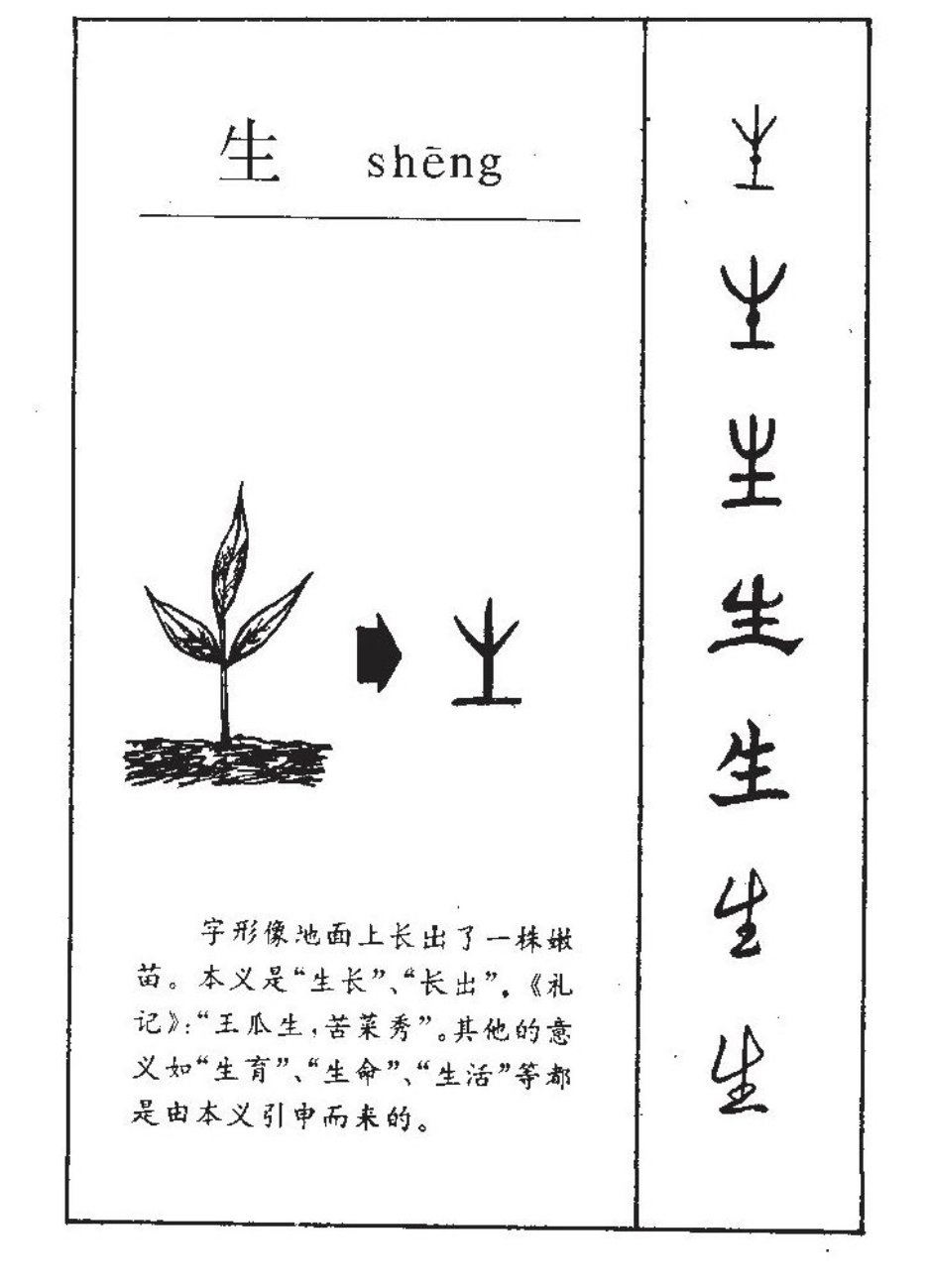
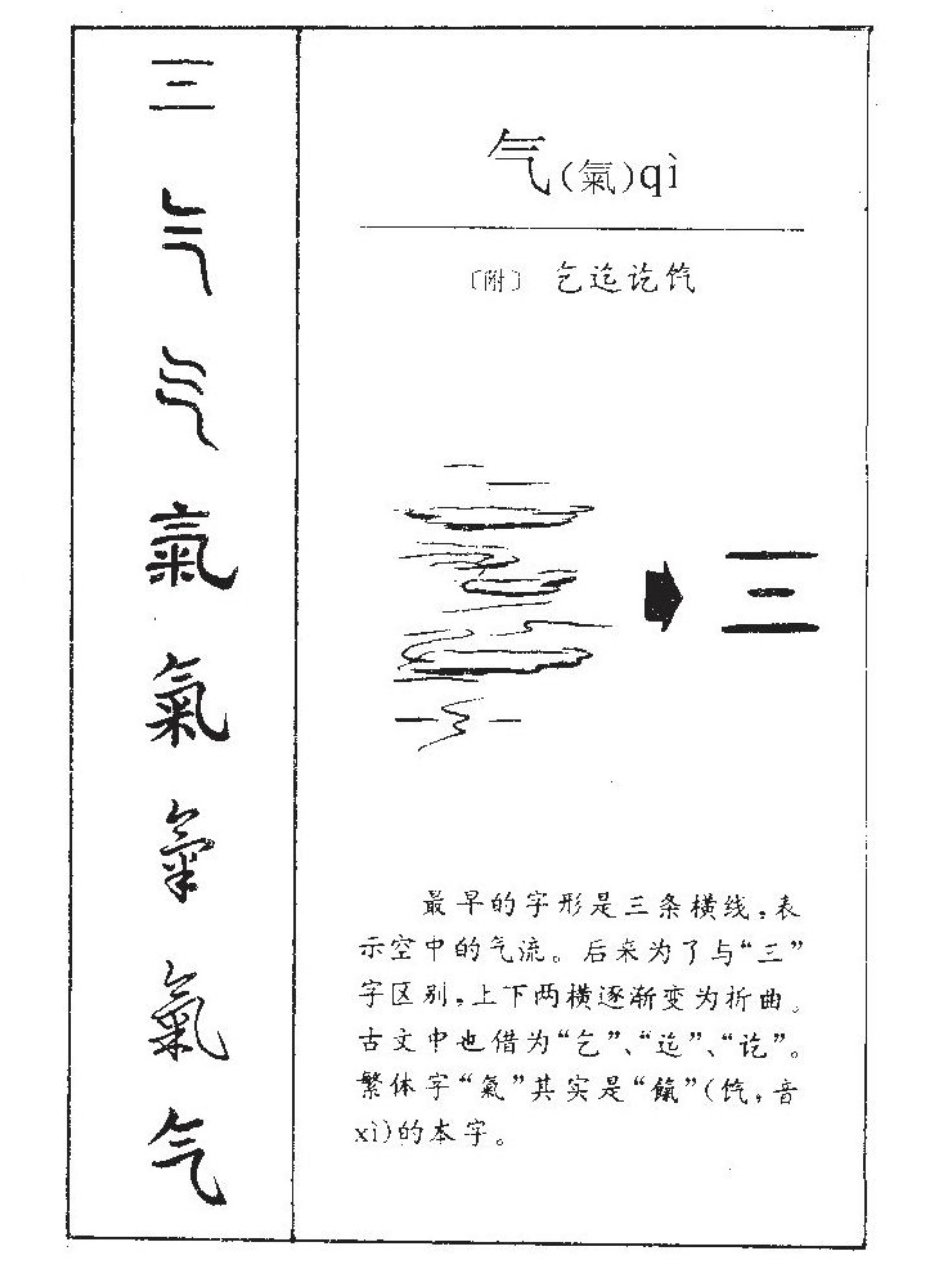
生气 (Sheng Qi) - These two characters combined means “angry” in Chinese.
生 means birth or growth
气 means air or energy.
These two Chinese characters basically means “the birth or growth of energy within one’s body”. This is interesting because anger does produce lots of energy within one’s body. The energy produced can be channeled productively. It is not uncommon to see many productive workers at times manifesting anger in a way that create challenges and conflict in the workplace. The same energy that often create drive and productivity is also the same energy that fuels anger.
The way to manage anger is to practice being attuned to the growing energy within us. Somatically, when a person is standing especially in a posture ready to take action (a body ready to move forward), it is this body disposition that drives productivity as well as fuels anger. If we want to diffuse anger, a possible intervention includes bringing our body downwards / backwards by sitting down or leaning back, kneeling, squatting etc to counter the birth or growth of the energy. This intervention can be applied during a conflict to diffuse your own anger.
怒 (Nu) - This character means “anger or rage” in Chinese. If we break down the writing of this character into two parts, we can see that on the top is the character 奴, which means “slave”. The bottom is the character 心 which means “heart”. This character basically means “a heart’s response when justice is not served (like being enslaved)”.
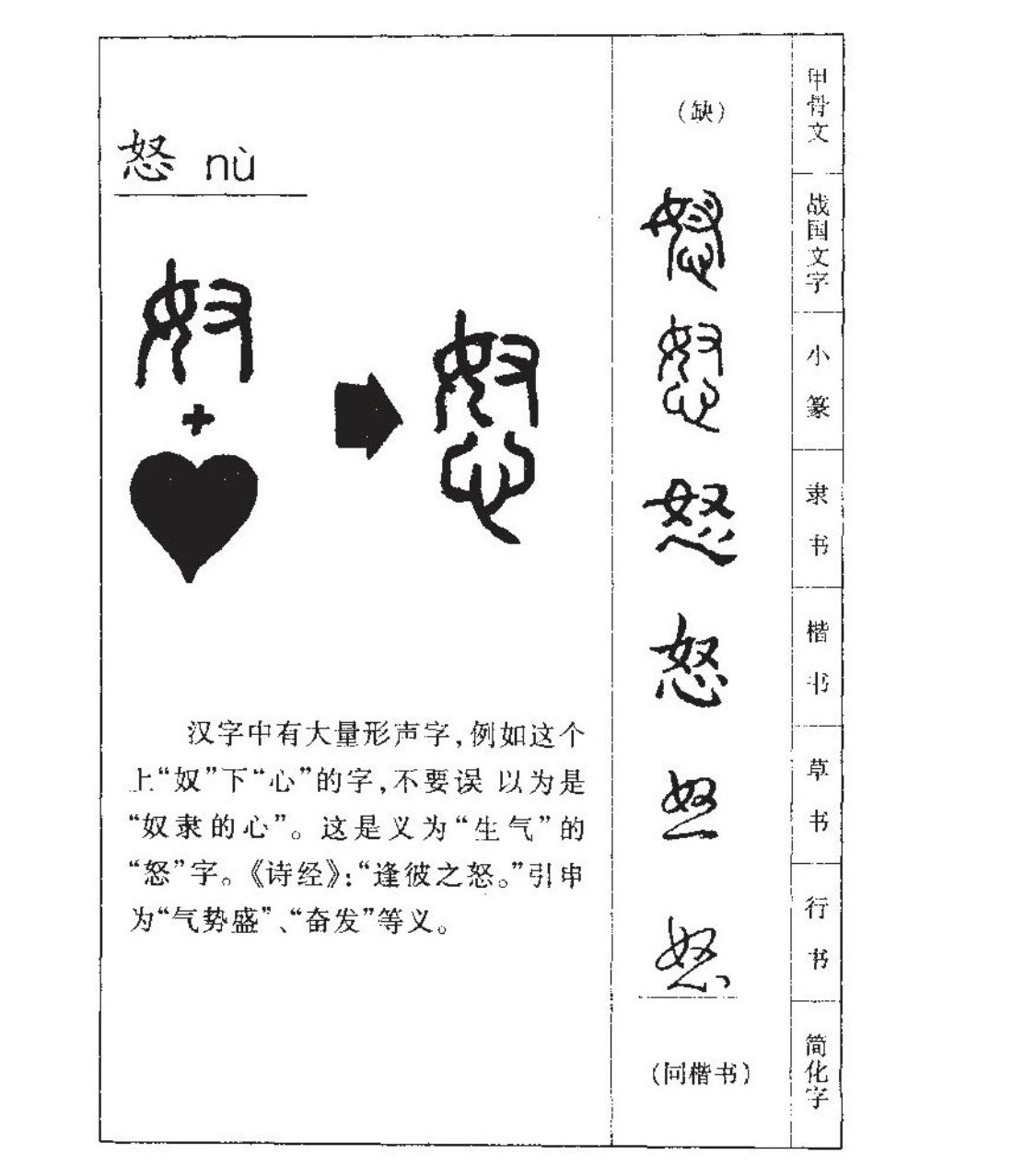
This gives us the idea that one of the purpose for anger as an emotion, is to propel us towards fighting injustice. When anger is harnessed effectively, we are able to intervene when there is bullying, oppression etc. Rather than judge the anger as a negative emotion, I often find it more useful in my coaching practice to help a person explore how the energy could be channeled productively.
Questions I have used to help someone explore anger:
What do you feel within your body feel whenever you get angry?
Who usually bears the brunt when you channel your anger in a not so productive way? How can you channel your anger more productively?
What are some areas of injustice you observed happening (at work)? How do you use your anger to intervene and fight the injustice?
What are some actions, behaviors or words that usually trigger your anger? What do you notice about your anger patterns?
Happy
In Atlas of the Heart, Brene Brown writes that there’s really no consensus in the research when it comes to defining happiness. When I looked into the different ways happiness is expressed, I found many different ideas as well. Here are three examples.
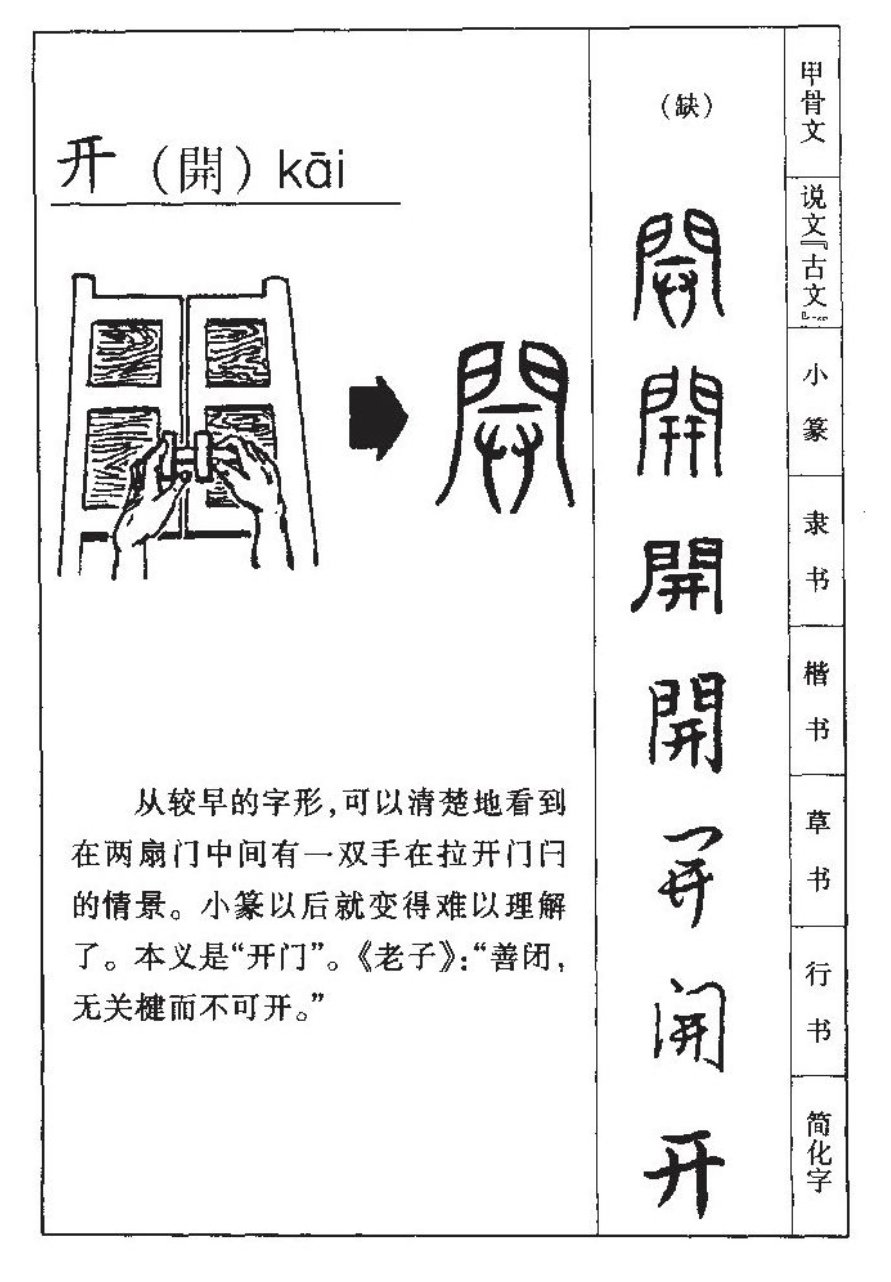
开心 (Kai Xin) - These two characters combined means “happy” in Chinese.
开 means open (seen from the picture of a door about to be opened).
心 means a human heart.
The description of these two combined characters basically means “the opening of a person’s heart”.
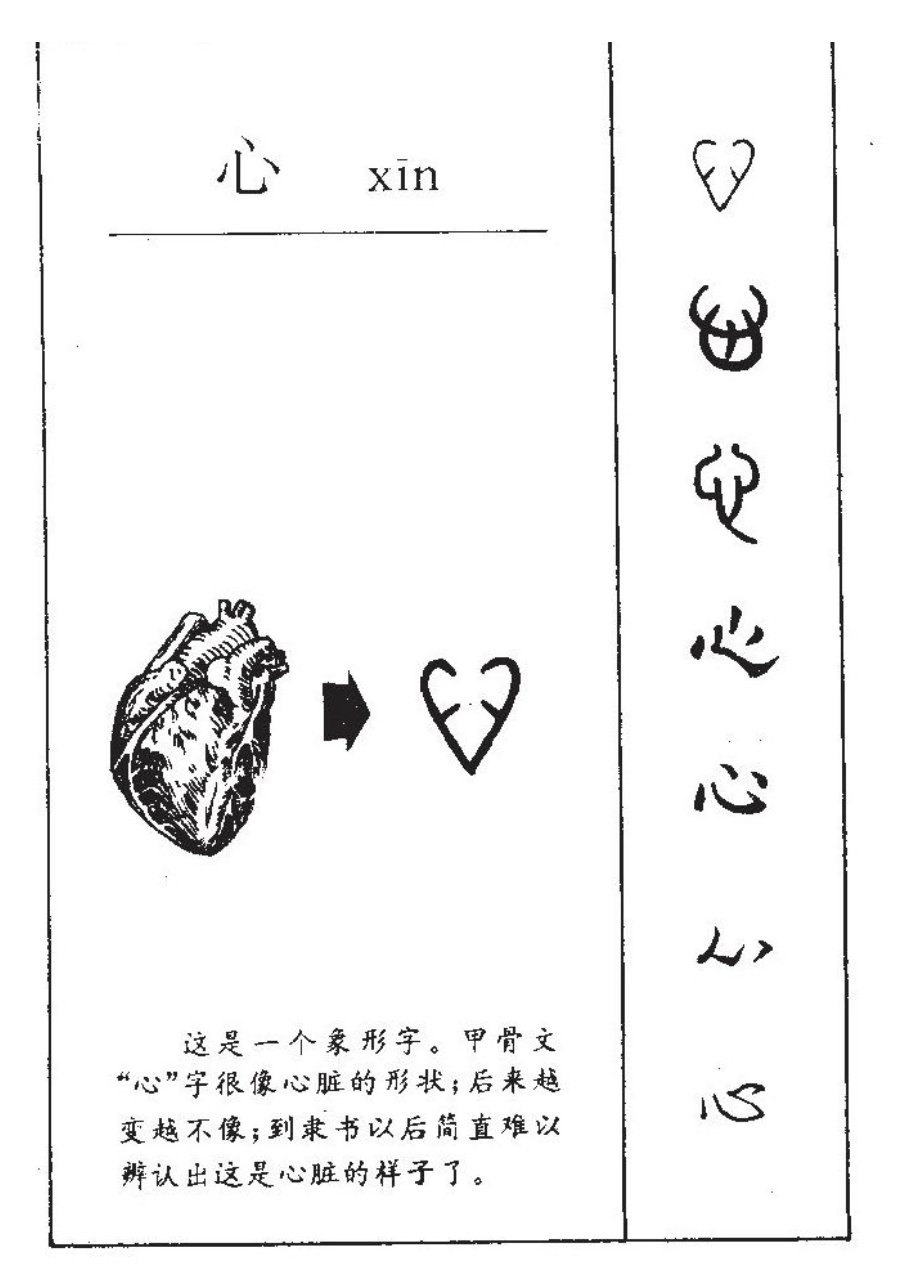
My own interpretation from this is that the capacity to experience happiness is strongly tied to the ability of a person to open up his or her heart to be vulnerable. When a person’s heart is opened (as opposed to closed), love and experiences of pleasure can be more easily received.
As an ontological coach, a possible design intervention for a person who wants to experience more happiness includes this somatic practice:
the opening up of the shoulders, or stretching of the arms wide to expand the chest area (and therefore the physical heart). The idea is that when the body becomes more open (especially at the chest area), the mind follows the body to expand the ability to be open towards others. Happiness is possibly a byproduct or a fruit from this somatic practice.
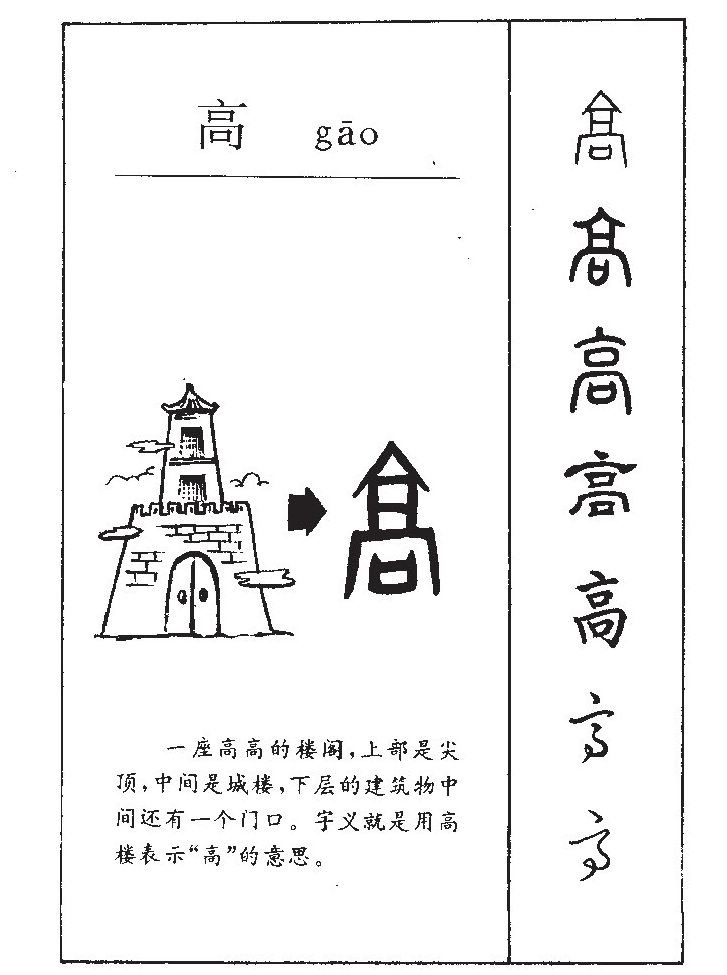
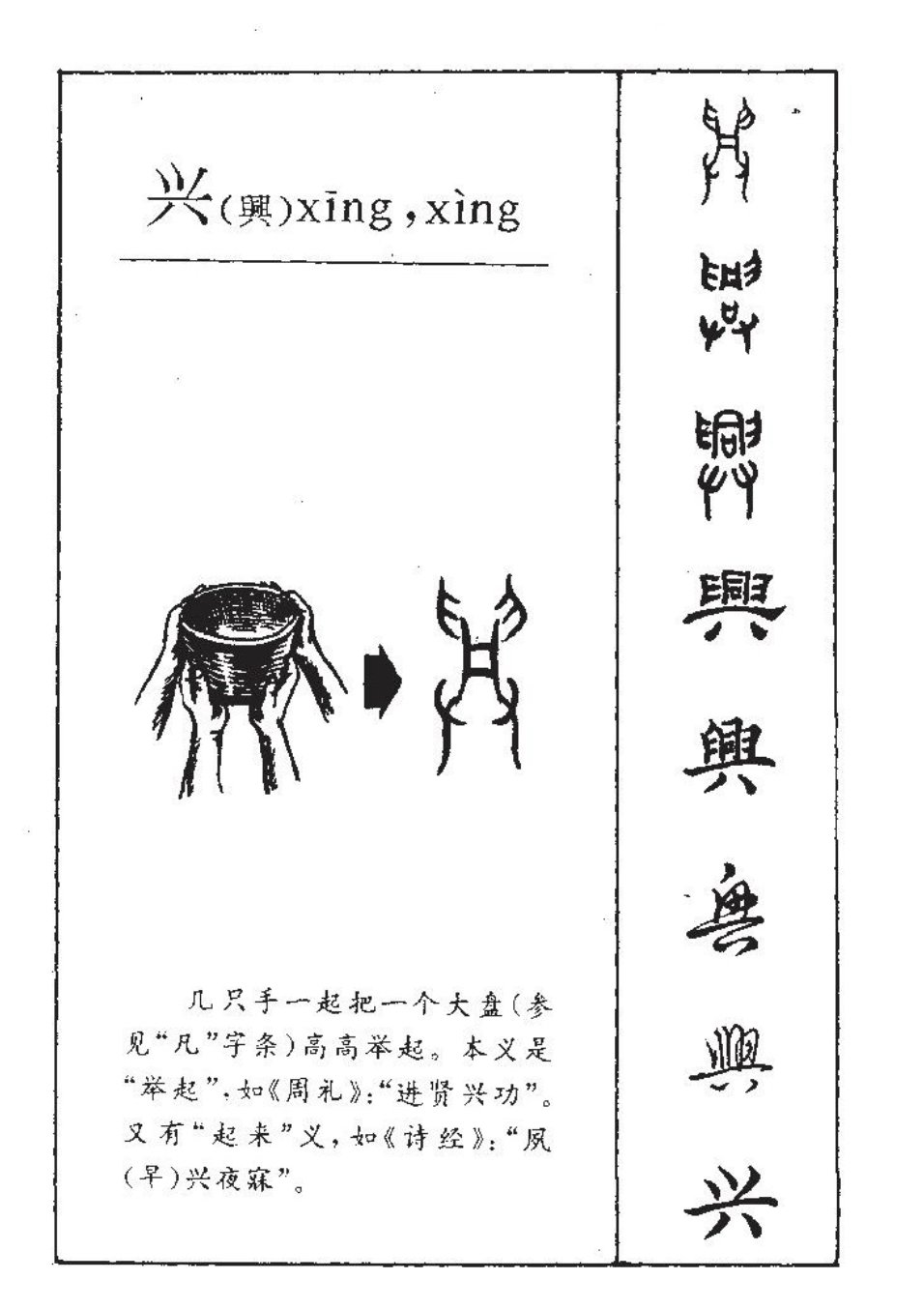
高兴 (Gao Xing) - These two characters also means “happy”.
高 means high/tall as seen from the picture of the tower.
兴 is a picture of many hands holding up a dish together as a celebratory act
From these two characters, the emotion of happiness can be interpreted as an emotion experienced from heightened state of togetherness, inclusion and unity. Happiness can thus be practiced when one is purposefully engaged in activities that bring togetherness and activities that foster inclusion and a sense of belonging.
快乐 (Kuai Le) - This is the third pair of Chinese characters combined to mean “happy”.
快 - This word has two meanings. It can mean fast or speedy. It can also mean the airflow towards the heart is smooth and unblocked.
乐 - This character means rhythm or music as shown by the picture of a Chinese musical instrument.
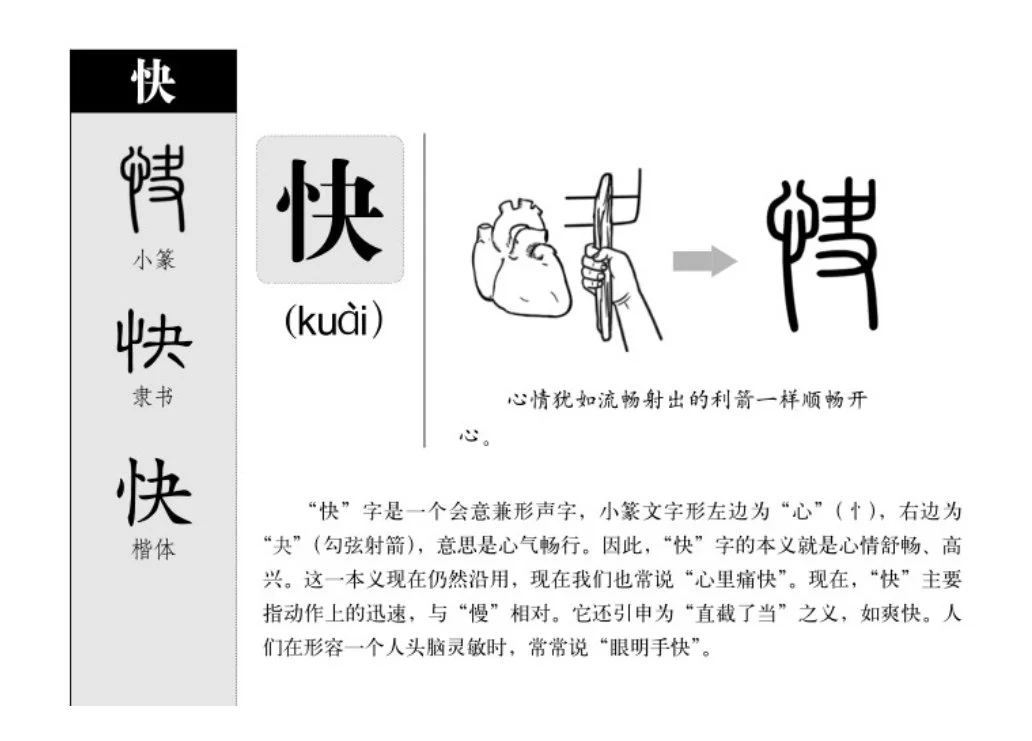

When these two characters are combined, they basically described things are smooth sailing like a piece of music played in perfect rhythm. As an ontological coach, I personally experienced happiness whenever I helped someone get “unstuck”. The feeling is similar to the description of the airflow being unblocked and the heart comes alive again. I personally found this discovery to be very fascinating.
Another way to read these characters is that they combined to mean “rapid / fast-paced” AND “rhythm/music”. Interestingly, music does affect our moods and celebratory music are often filled with fast rhythms.
It is worthy to note that we can practice changing the mood and emotion (of an environment or of a person) to a more light hearted one by the intentional use of music.
Fear
Fear can be defined as an emotion experienced when one assessed that something valuable could be potentially lost.
怕 (Pa) - From the picture, this character describes the heart as empty and there is a loss of something of great value, something very precious to a person’s heart. Other than fear, this particular character also means “worry” in the Chinese language context. From this character alone, it is quite interesting to observe that fear and worry often come as a pair.

As a coach, applying this knowledge allows me to help a person explore fear by examining what is of great value and precious to the person’s heart. Simply by asking a question such as “what is of great value to you that you fear losing?”, the conversation becomes a very rich one. I also discovered through my coaching sessions, a conversation about fear and worry often leads to a deeper examining of relationships and items that are of great value to a person. And this further leads on to whether a person’s life is aligned to his / her value system.
In summary: Having struggled with naming and understanding emotions, I have a firm belief that helping others name and understand their emotional life can bring significant breakthroughs. I hoped you have benefitted just as I have after researching about the Chinese language and human emotions. I have certainly expanded my own knowledge and abilities as an ontological coach.

Written by Victor Seet
Activator • Communication • Strategic • Self-Assurance • Command
As a Gallup and Newfield Certified Leadership Coach in Singapore, Victor is passionate about helping people be better observer of themselves to achieve the results they want, especially in the area of well-being and performance. Victor intentionally integrates the strengths-based and ontological approach into his leadership coaching and workshops.
**sources:
Atlas of the Heart by Brene Brown;
www.chaziwang.com.