
What is Leadership Range? And Why You Can’t Think Your Way Into It
Leadership range is the ability to take the stance a moment needs (Stability, Resolve, Openness or Flexibility) on demand, including the ones that don’t come naturally. It’s built through the body, not by thinking harder, because under pressure we fall back on the stance we’ve practised most.
Leadership range is the ability to take the stance a moment needs (Stability, Resolute, Openness or Flexibility) on demand, including the ones that don’t come naturally. It’s built through the body, not by thinking harder, because under pressure we fall back on the stance we’ve practised most.
As a parent, one of the most common and relatable issues I hear from other parents is how we show up for our kids and even to our spouses.
What do I mean by showing up?
Here’s a story. I came back home from work and my son ran toward me and proudly showed me a Lego structure he had built. Instead of sitting with him in his proud moment and giving him my attention, I asked “Have you finished your homework?”
Some might think that I meant well, and the principle I’m trying to teach is to finish up one’s work before play.
The question I asked was reasonable. What might be questionable was the stance I brought towards my son. I showed up ready to enforce my beliefs, at a moment that needed me to slow down and receive.
Some of us might have a similar moment somewhere in our week. We bring the right skills with the wrong stance (and the wrong stance often brings forth a type of energy that is unhelpful for the situation).
And because we judge ourselves by our intentions, we rarely notice.
My hawker friend knows something we often do not notice
I have a friend, DX, who owns a hawker stall selling fishball noodles. Watching him during the lunch rush was interesting. When the queue gets restless, he doesn't flinch. He keeps his rhythm and focuses on his cooking. His bowl of noodles is consistently delicious (in my opinion) and probably the reason for the queue. When the supply of cut chilli padi runs low, halfway through the rush, he shrugs, stops cooking and goes to refill the container with fresh chilli. When an old auntie comes up, a regular customer, he softens. He asks about her knee. He smiles and listens. And when a customer requests to have the noodles prepared in a particular way, he stops, listens and improvises to serve the customer. You could observe the delight shown on the face of the customer.
Same man. Same thirty minutes. Four completely different ways of standing at the stall. He isn't switching personalities. He's switching stances. And he does it without thinking, because the situation in front of him is so clear. DX has what I call leadership range: the ability to move between stances as the moment demands.
Not all of us switch stances as naturally as DX. At work and at home, I notice it is rarely that easy. The question that comes to my mind is: “How do I show up in a way that serves what the moment needs?”
Four stances every leader needs
In my work with leaders, I look at four stances.
Stability is the stance of keeping things steady. Our weight settles. Our breath slows. We stop rushing and we steady ourselves. People around us borrow our calm before they have even heard what we are saying.
This is the stance for the town hall after a restructure, or the meeting after a bad quarter, when discouragement fills the room. It's also the stance when we experience our six-year-old kid melting down in the supermarket. In that moment, what you say matters far less than whether you are steady.
Resolute is the stance of recommitting when things get hard. Our eyes lift to the horizon. Our breath goes into the effort. We come back to the goal, again, when it would be easier to allow resistance to pull us back.
This is the stance for during the last quarter of a year-long project, when the early energy is gone, resources have dwindled and people start quietly asking whether it was worth it. We choose to recommit the team. We hold the team to what they agreed to and rally them to persist. At home, it's returning after a long tiring day of work to see the huge pile of dirty clothes. We spent the energy finishing up the laundry and see through what is needed for the family.
Openness is the stance of inviting or letting someone in. Our chest softens. Our shoulders drop. We speak less and listen more, and we resist the urge to fix. We invite others to collaborate because we value the connection and partnership.
This is the stance DX chose with the auntie. It's the one-to-one chat, remembering what she told him about her knee operation and he chose to care despite the queue. At home, it's 11pm, when our teenage child walks into our room and starts talking about something hard, and the best thing we can do is be present and listen silently rather than fix.
Flexibility is the stance of seeing another way. We’re lighter on our feet. Curious. Our posture loosens and so does our thinking.
This is the stance for the strategy offsite when new conditions emerge in the market. For the project team that has to deal with a sudden departure of a key member. For the brainstorm where everyone keeps circling the same three ideas. At home, it's the family outing that got disrupted by the heavy rain. We turn the disruption into a better afternoon instead of a sulk.
Every stance has a shadow
All four stances are body dispositions. None of these stances is in itself the best. The trouble starts when we can only access one or two of them.
Stability, overused, becomes immovability. We become a wall, and people stop bringing us their problems. Resolute, overused, becomes the bulldozer. We get compliance, but not commitment. Openness, overused, becomes people-pleasing. We end up accommodating everyone and deciding nothing. And Flexibility, overused, becomes flakiness. Lots of ideas, little follow-through, and nobody can predict what we’ll do next.
Our home stance and the debt it builds
Most of us already know we should be stable in a crisis and open when someone needs a listening ear.
Knowing isn't the problem.
The problem is pressure. We can know we need to be more open and still find our arms crossed and our jaw set the moment we are under pressure. Knowing about a stance and having access to a stance are different things. One is head knowledge. The other is body intelligence.
When the stakes rise, we fall back to our home stance, the one our body has practised for years.
For me, my home stance is Resolute. It helps me get results at work. It's also why, in my moment with my son, my body leaned forward to ask about homework before my mind caught up. I also struggled immensely when I started out as a professional coach. It’s not hard to predict the reason. Resolute was the stance I leaned into most while neglecting the practice of the other dispositions.
In ontological coaching, we see body, emotion and language as tightly linked. The way we hold ourselves shapes the moods available to us, and those moods shape what we are able to say and do. If we change only the language, we say the right words in a posture that contradicts the words. And people notice the incoherence. Through my coaching experiences, I notice that when the body shifts, the words and moods tend to follow.
I could watch my friend DX at his fishball noodle stall, study his technique for a year, write down exactly what he does, and remember all the steps, and chances are that I still wouldn’t be able to do what he does. He didn’t learn it by understanding it. He learned it by doing it ten thousand times until his body knew.
Every time we bring our home stance to a moment that needs a different one, we take on a little disposition debt. The debt doesn't show up on any dashboard. It shows up as the team that stops bringing us information. The peer who goes around us instead of through us. The teenage child who used to tell me things and now says "fine." And like most debt, it compounds quietly until one day the bill arrives. The price is paid in trust, in honesty and in conversations that should have happened months earlier.
Range, not reinvention
So how do you practise changing stance in the moment.
There’s an important distinction that I would like to highlight - the practice of building RANGE.
Building range does not mean becoming a different leader or person.
The Gestalt tradition has a useful idea here: change tends to come when we fully notice who we already are, not when we strain to become someone else. Leaders who try to overwrite their home stance usually end up exhausted and unconvincing. Leaders who first get to know their home stance well can start to notice the moment it takes over. And that noticing is where choice begins.
So the goal is to become fully aware of how our home stance shows up - positively and negatively. Keep our home and add more places we can reach. That’s what range means: being able to take the stance a moment needs, on demand, including the ones that don’t come naturally.
What this looks like in practice
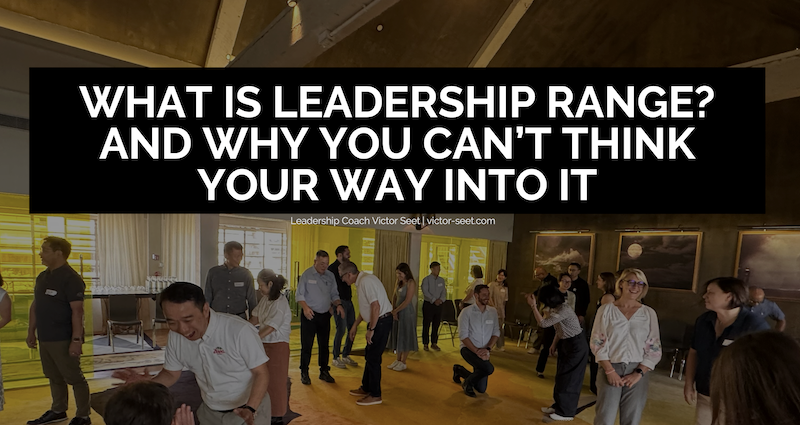
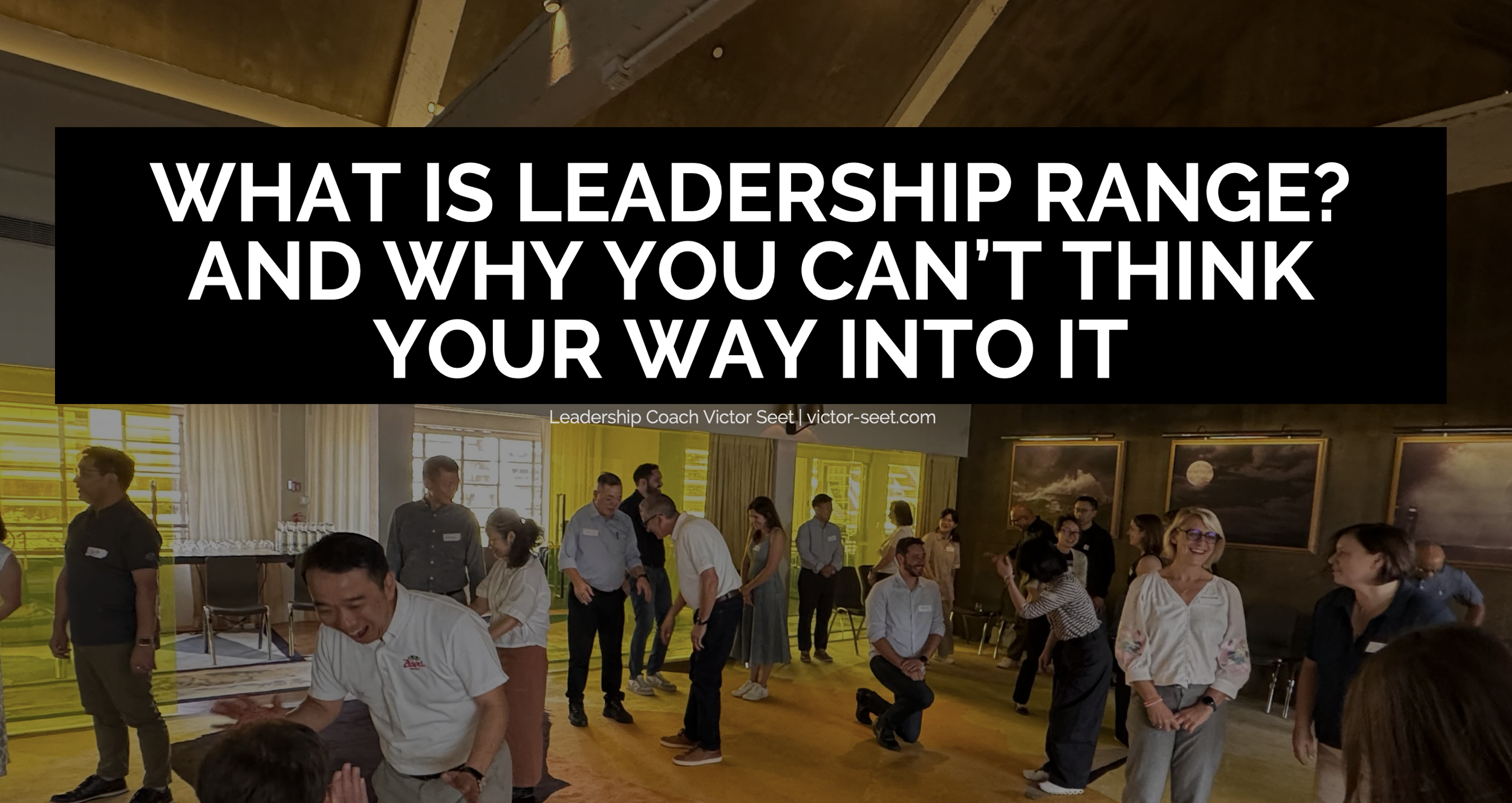
In October 2026, I worked with thirty senior leaders from twelve countries during their strategy week in Singapore. There was no pre-work and no profiling. Instead, each leader physically practised all four stances and noticed where they felt at ease and where they met resistance. This was an embodied self-awareness practice. Many leaders were surprised that their bodies told a different story from their heads.
The real value came from a facilitated feedback exercise. Colleagues told each other which stance they usually noticed in each other, and which one they wish they saw more of. That’s hard to hear. It’s also something no leader can work out on their own. That brought real insights.
If you’d like to explore this with your leadership team, Expanding Range is a half-day embodied leadership workshop built around these four stances. If you’d rather work on your own range, one-to-one ontological coaching gives you the space to do that at your own pace. Either way, I’d be glad to have a conversation about the range you are building as a leader and how I can support you in your leadership development.
So, which you does the moment need?
You probably already have a sense of your home stance. The more useful question is: which stance do you find hardest to access when the moment requires? And who around you has been paying for it?
Just remember that the practice is not by thinking harder. Your stance lives in your posture, your breath and your pace, so that's where the shift begins.
I'd love to hear where this landed for you.