
A Manager’s Guide: Using CliftonStrengths (StrengthsFinder) in Personal Development
Gallup reports in its research that a manager plays a huge part in determining if an employee will be engaged at work. Singapore Ontological and CliftonStrengths coach Victor Seet, shares how he uses his CliftonStrengths results to grow himself as a manager.

In 2016, Gallup scientists found that managers account for at least 70% of the variance in employee engagement across business units. This simply means that managers have a lot of influence on an employee’s performance and engagement level. Gallup also reports that strengths-based interventions can result in a 9-15% increase in employee engagement.
In short: empowering managers to focus on their strengths and the strengths of their teams is key in increasing employee engagement.
As a Gallup-Certified CliftonStrengths Coach and manager myself, this is my mandate. I need to:
(1) know and understand my own dominant CliftonStrengths themes,
(2) have ownership of them, and
(3) intentionally aim my strengths towards my goals as a manager.
My leadership belief is to lead by example, and I strongly believe that all influence flows first out of our own personal growth and transformation. I know I’ve made an impact when the team members around me are influenced by the way I choose to lead. This article was written to share about part of the personal journey I have taken to grow myself as a Strengths-Based Manager.
How can a manager use CliftonStrengths (formerly StrengthsFinder) to develop himself?
Step One: Understand Your Dominant Themes as a Manager
I started digging into all the resources I could get my hands on to learn more about my dominant CliftonStrengths themes. I did what the Gallup Strengths Action Report advised me to do: I took a pen and underlined everything that resonated with me in the reports. I watched all the different videos I could find to get a greater understanding of my talent themes. I also scoured the Internet for articles that I felt would aid me in my understanding.
But I have to admit: that whole process was somewhat tedious and challenging for me. Resources were scarce back then. This experience led me to create a bank of resources for managers like myself, who desire to learn and understand more. My hope is that these resources will accelerate the learning process for others.
@@The first step to understanding our talents themes is to reflect on our behaviors, habits and past experiences.@@
For example:
Activator: I realized my Activator gives me the desire to always be on the move and to do things fast. Because of this need for speed and sense of urgency, I am easily upset when my family takes their own sweet time to get ready whenever we’re going for a family outing. I also realized that I enjoy going on drives with my two sons. One of my favorite ways to spend some quality time with them is to take them on bus and train rides, even if there’s no particular destination we have in mind.
Communication: I realized that I am a lot more productive when I can air out my thought processes and share them with others. The process of sharing my ideas sharpens my thoughts. I have often improved on many of my ideas in the midst of sharing them with others (without them giving any input). I now understand how verbal processing works in reality!
Maximizer: I realized that I really struggle a lot when I’m tasked to create something from scratch. That’s because of my Maximizer theme. In contrast, I’m extremely efficient when I’m given a template or something to work with: I can turn the existing materials into a brilliant piece of work.
Strategic: I realized that I inherently enjoy options. I intuitively look for other alternatives and I often refrain from making any decisions when I do not have any alternatives to make comparisons. I enjoy browsing many different websites to compare prices while doing online shopping. I’ll also walk around an entire shopping mall looking for good eateries and comparing options when I’m deciding on where to have a meal.
@@To connect our CliftonStrengths themes to our past experiences is to bring the knowledge from our heads into our hearts.@@ As I reflect on my own life more and more, I begin the journey of claiming and owning my dominant themes in greater measure.
Action Step: Can you connect your CliftonStrengths talent themes to your past experiences, patterns of thought, or habits? Try doing this for each of your top 5 talent themes.
Step Two: Own Your Dominant CliftonStrengths Themes As a Manager
Taking complete ownership of your CliftonStrengths themes is by no means an easy feat. Ownership comes when we start to accept and view our CliftonStrengths lenses in a positive way. @@Ownership drives us to action.@@ If we dislike our CliftonStrengths themes or are skeptical about them, we won’t be able to aim them toward specific goals we have our work and personal lives.
I’d like to recommend one step that I have personally found helpful in building greater ownership of my strengths: @@Link your CliftonStrengths themes to an identity that you could assume at work.@@
For example, as a person with Activator as my number one CliftonStrengths theme, I see myself as a “Catalyst”. As I read the description of the Activator theme, this idea stands out for me and I know I enjoy working on great ideas by kicking-off projects.
For example, one of the projects I started at work was the Strengths workshops for Couples. The idea came out of a brainstorming session. In my mind, the workshop would be short so as to cater to busy couples in Singapore. Since I had personally experienced a powerful transformation in my own marriage in employing the CliftonStrengths tool, I thought this idea was brilliant. So after the brainstorming session, I immediately set a date for the workshop to happen, booked a venue, and within a month, the first Strengths couple workshop was birthed. It went very well and we have been running these workshops regularly ever since.
Being a Catalyst is an identity that I took ownership of, not just in my professional life but also in my personal life. In church, I saw the benefits of joining a men’s group for mentorship and accountability. Immediately, I rang up a couple of close male friends and we joined the men’s retreat and got connected to other men in church. That allowed us a place to share our career journeys and individual struggles. The support we received was helpful and immediately felt.
This identity of a Catalyst helps me to own my CliftonStrengths Activator theme in a greater measure.
I have also observed how my other colleagues took on different identities that helped them to own certain kinds of work tasks, which in turn helped the team become more productive. When I was leading the team in Strengths School, we have a Creative Designer (Ideation), Researcher (Input), Fashion Consultant (Individualization), Data Analyst (Analytical), Welfare IC (Developer), and so on.
Action Step: Based on your CliftonStrengths themes, what identity can you assume and build greater ownership of in your work role as a Manager?
Step Three: Aim Your Dominant CliftonStrengths Themes as a Manager
Aiming our CliftonStrengths themes consists of two aspects. The first is understanding the negative impact that our strengths can have on our team members at work. The other is about intentionally connecting our dominant themes with specific, actionable goals tied to broader work outcomes.
Aspect 1: Understanding Our Impact on Others as Managers
As I reflected on the way I’ve led my team in the past, I had a realization: We see the world through our CliftonStrengths lenses. As a manager, I’ve learned that:
I must be aware of the areas I tend to impose my thoughts and decisions on my team. For example, I have a tendency to drive the team to act quickly because I believe that business opportunities are lost when one fails to move quickly. This is linked to my Activator lens. Knowing this at the back of my head empowers me to be patient with others in the team who prefer to think through risks and challenges (such as the Deliberative or Intellection themes). This knowledge pushes me to look for common ground rather than imposing my beliefs on them.
I must be aware of what my natural behaviors are, particularly in times of stress. For example, as someone with Activator, Communication and Command, I know I am prone to immediately responding with raw and emotionally-charged words, usually without thinking. This is especially so when I perceive some kind of aggression coming from another person. Being aware of this tendency empowers me to do two things: firstly, I now have a greater ability to catch myself exhibiting this behavior, especially when I notice the body language and response of my colleagues. This allows me to effectively reduce the damage done as a manager by quickly pulling back this destructive behavior. Secondly, I am now able to explain my tendencies to my team and colleagues and empower them to help me. They know that they can call for a time-out when they sense that the discussion has reached an agitated state. They can also find different ways to calm me down and find out why I feel agitated.
I must be aware of my leadership style and how that relates to my strengths. For example, I am a high risk-taker and I have the propensity to take on projects that bring the team into unchartered territory. Understandably, that often causes a lot of stress on the team. This tendency comes from my Self-Assurance theme. Knowing this helps me to make more effort in explaining the background and reasons on embarking on specific projects as well as hearing the feedback from the team.
Aspect 2: Connecting Our Strengths towards Goals
Aiming our strengths is about intentionally connecting our CliftonStrengths themes with specific, actionable goals tied to work outcomes. Employing the use of SMART goals in aiming our strengths is highly recommended. Careful consideration has to be given when setting these goals. Personal discipline also has to be exercised to stay focused on working out these actionable goals. This is where accountability partners can be of great help. We need reminders and help to stay on track.
Some personal examples of goals I’ve set in the past:
Activator: As a Business development person, my goal was to connect with 50 new organizations within a year and convert 20% of them into clients
Communication: As a Strengths Coach and advocate, share with and influence 2000 people in Singapore and Asia to do the CliftonStrengths profiling assessment within a year
Strategic: As a business owner, get recurring business from 80% of our existing clients within a year
Self-Assurance: As a CliftonStrengths Coach, facilitate one CliftonStrengths workshop in a language other than English, and do it proficiently within a year (I measured this by making sure I scored at least 4 out of 5 in my overall trainer evaluation)
Command: As a leader, do a check-in with each staff on a monthly basis and make sure each person gets clear of “what’s expected of them at work” so that they can deliver the results.

A word of caution here: Ever since I started to aim my strengths towards my work goals, I have faced certain resistance. Some of these challenges were external. For example, a sudden surge in urgent matters demanding my attention. Other times, the challenges were internal. The resistance comes from a sense of fear and doubt in my personal ability (which can be completely irrational in nature). Sometimes, the fear can push me towards shifting the goalpost. Working on our strengths is not as easy as some might imagine to be but it will be rewarding!
Concluding Thoughts: When I made a decision to focus on being Strengths-based, I intentionally share with my team about how I use my CliftonStrengths themes at work. I share about the things that make me tick as a manager and how that relates to my talent themes. I share about my decision-making processes and how my different talent themes inform my decisions. I share my personal reflections on what I feel about my strengths and how I can develop myself. I conduct debriefs to get feedback on how my talent themes value-add to the different projects. I try to get 360-degree feedback to understand which of my strengths hinder me in being a successful manager. I believe firmly that our daily actions, conversations, and lifestyle must show others that we are Strengths-Based Managers.
Written by Victor Seet
Activator • Communication • Strategic • Self-Assurance • Command
As a Gallup and Newfield Certified Leadership Coach in Singapore, Victor is passionate about helping people be better observer of themselves to achieve the results they want, especially in the area of well-being and performance. Victor intentionally integrates the strengths-based and ontological approach into his leadership coaching and workshops.

The Power of Naming An Emotion
We can only intervene in what we can see. This article is about how the process of therapy had helped to give a name to an emotion which had troubled the writer. That empowered him and brought a change in his marriage.
In the middle of 2019, I took a sabbatical from my coaching work and left my company. One of the main factors behind my decision was the state of my emotional health. At the start of 2019, I had several indications that I was already not doing well emotionally. There were several incidents where I had allowed rage to get the better of me. These emotional outbursts happened at home and at work. However, I told myself that this was a normal phase in life. After all, I was living in a fast-paced and competitive society in Singapore, living a stressful life as an entrepreneur and being a father to 3 young kids.
The Tipping Point
However, by mid 2019, I had to stop telling myself the same narrative. The tipping point was a particular episode I had after a team debrief. As a company, we had just completed our largest training project - in terms of revenue and the number of training participants. The project was especially remarkable because it was birthed out of an innovation. There was no template, no previous experience of such kind and the team pulled it off. To top it off, the feedback from the participants was fantastic. The debrief was intended to celebrate this huge success and to brainstorm ways to overcome operational challenges. Unfortunately, the debrief did not turn out the way I hoped for it to go. Instead, I had an outburst, the brunt of which was borne by some of my team members. Emotionally, I felt horrible. That pain was significant enough to make me dread turning up for work. I eventually decided it was time I do something to address this issue. Stopping work was the first step.
On the home front, my wife and I had been discussing the idea of attending a therapy session together. The discussion started several years ago but we never got down to doing it. In the second month of my sabbatical, there was a particular conflict which we debriefed and reached agreement on. Regarding the state of the marriage: we were getting by but hardly thriving. We reached a consensus and agreed to attend a therapy session together. “Let’s do it.”
Going through Therapy
Based on some recommendations, we chose an organization called Counselling and Care Centre. They assigned a senior therapist to us and fixed a date. The first visit to the therapist was one filled with uncertainty. I had no idea how the session would turn out. Thoughts were flying through my head: “Will there be some deep issues flushed out during our conversation? Am I ready to hear them? What will my reaction be like if the wife said something that I’m not ready to hear? What will her reaction be if I did the same?” In the end, the fears were unfounded. I was relieved when I asked how she felt about the session and her response was a exuberant one. “Therapeutic!”
Naming my Emotion
We attended a few sessions together and we also had individual sessions. The third joint session, in particular, had a deep impact on me. I left that session feeling quite overwhelmed. Some raw emotions surfaced. During the session, I shared some of my feelings of frustration: there were many things I did which I received negative feedback from my wife. I felt I had done my best though. The feedback made me feel like my best was not enough. The therapist had us revisit some of these situations and eventually, my feelings of frustration was named: an emotion of defeat. I suddenly had an awareness that this feeling of defeat was not isolated to the marriage relationship. It was a feeling I had consistently experienced through out my life. I assessed that this emotion was what contributed to some of my worst outbursts.
READ: WHAT IS MY HEALTH WORTH?
I remembered feeling defeated when I was young. I scored an own goal in a soccer match and at the end of the match, I was ridiculed and laughed at. That experience left a stigma. I also remembered feeling defeated when I was learning to play a particular board game. I was thrashed by my opponents and humiliated. I felt utterly beaten. In the more recent years, I remembered feeling defeated when I was passed up for a promotion. The feeling of not being good enough for a promotion despite giving my best was very very strong. I remembered that particular incident made me depressed for a month. The most poignant realisation was identifying this same feeling of defeat at the team debrief which I mentioned earlier. That feeling of defeat ultimately led me to taking a sabbatical break. I remembered feeling that I had given my best to serve the team and led the team to a successful completion of the project. The debrief outcome however made me realized the success came at a far greater cost to the team. Trust was broken and relationships were strained.
Conclusion: We cannot intervene in what we cannot see. In naming this emotion of defeat, I now have something to work on and that has given me much hope. My marriage has also taken a different turn. A greater level of trust had been rebuilt and our ability to communicate had strengthened. I feel that my emotional health is now at a much better place. I have since ended my sabbatical and started a new journey. I now focus on helping people integrate strengths using the ontological approach in Singapore and across the world. I have continued with my therapy which has served me to become a better coach. I am able to observe my therapist in action and concurrently explore areas of growth. I now have a greater confidence in my coaching work.
This article is the second in the series of my Halftime journey.
Written by Victor Seet

Speed-Based StrengthsFinder Theme Combination
Ever wondered why some people make decisions almost instantly while others take much longer and why this creates friction in teams? Singapore Ontological and CliftonStrengths coach Victor Seet explains how certain strength themes are fundamentally shaped by speed, and what this means for teamwork.
As a person with Activator as my top CliftonStrengths (formerly StrengthsFinder) theme, I love the idea of being fast. I have decided to share some of my thoughts on the CliftonStrengths themes using the idea of “speed”. As someone who enjoys illustration by contrast, I will discuss some commonly perceived StrengthsFinder themes based on the idea of “fast” and “slow”. This is a follow up article to the last one I wrote.
READ: TIME-BASED STRENGTHSFINDER THEME COMBINATION
CliftonStrengths “FAST” Themes:
Activator: Those with Activator in their top 5 CliftonStrengths results or dominant themes are usually known by their friends as being impatient and impulsive in nature. Activators tend to be “FAST in taking action" because of their unique wiring. “Actions speak louder than words”; “I learn as I do”; “Take action now before the opportunity is lost!” These are common thoughts tied to Activators. We can describe them as people who move fast but they are often seen as those who do not think things through and prone to make unsound decisions.
Strategic: Those with Strategic in their top 5 CliftonStrengths results or dominant themes are usually known by their friends as those who are “FAST to provide alternatives”. People with Strategic intuitively see different paths to the same destination and love to explore the best option. We can describe them as those who can think quickly on their feet and talented in finding shortcuts. However, they can also be perceived as those who jump to conclusions rather quickly instead of taking time to hear what others have to say.
Woo: Those with Woo in their top 5 CliftonStrengths results or dominant themes are usually known by their friends as those who are socially adventurous. They are “FAST in making connections with people” and they usually pride themselves as sociable, outgoing and friendly. People with Woo enjoy connecting wide rather than deep and their speed in connection sometimes cause others to label them as “social butterflies”. They can also be perceived as people who prefer to make social connections over completing work tasks.
Adaptability: Those with Adaptability in their top 5 CliftonStrengths results or dominant themes are usually known by their friends as those who are easy going and flexible. They are “FAST in responding to sudden changes” and can be seen as highly spontaneous in nature. This unique ability empowers them to bounce back quickly and respond to dynamic situations. As opposed to many who prefer to be adequately prepared in nature, people with Adaptability can sometimes be perceived as those who are reactive rather than anticipatory.
READ: UPDATED GUIDE: USING CLIFTONSTRENGTHS FOR WORK
CliftonStrengths “SLOW” Themes:
Context: Those with Context in their top 5 CliftonStrengths results or dominant themes are usually known by their friends as people who enjoy reminiscing the past. Knowing the past helped those with Context to find emerging blueprints as well as tried and tested solutions. Before making a decision, those with Context need to know what has happened before, what contributed to the existing situation, why certain decisions were made previously etc. We can describe them as people who have a special ability to keep the connections between different generations by building on past successes. Because of the need to understand background and past information, people with Context are perceived to be “SLOW in decision making”. They can sometimes be long-winded and share unnecessary details when they chair meetings. They can also be perceived as those who drag out meetings because of the tendency to ask questions that require extensive sharing of background information and past data.
Relator: Those with Relator in their top 5 CliftonStrengths results or dominant themes are usually known by their friends as those who are authentic, trustworthy, loyal and will go the extra mile for their close friends, regardless of inconvenience. They take time to forge deep connections, believing that people take time to open up their hearts and build trust. We can describe Relators to be those who break work barriers and are able to cultivate genuine friendships. A work team filled with Relators can have the potential to build extremely tightly knitted groups with high trust and loyalty to one another. Relators can be perceived as “SLOW to warm up to new faces” and are cliquish and unfriendly. Relators can struggle in environments where the need to build fast connections is a work requirement.
Deliberative: Those with Deliberative in their top 5 CliftonStrengths results or dominant themes are usually known by their friends as those who are careful, attentive to details and socially private. They take time to think deep in order to assess potential danger. They are very confident once they have their own conclusion after adequately assessing the risks involved. They thrive in work that require high governance and strong attention to details. However, they can often be misconstrued as “SLOW in decision making” especially when urgent and quick decisions need to be made.
Harmony: Those with Harmony in their top 5 CliftonStrengths results or dominant themes are usually known by their friends as those who are collaborative and peace-making. In a team setting, people with Harmony dislike conflicts and will make efforts to hear each person out and to find a common ground to move forward. As a result, they can be “SLOW in decision making”, preferring to make sure people’s opinions are considered than to make a decision of their own. They take time to find consensus and get alignment in order to move forward. They thrive in work that require strong teamwork and are often the glue in holding together a high performance team.
CliftonStrengths (StrengthsFinder) Theme Combinations:
When any two of the “fast” CliftonStrengths themes are within the dominant strengths of an individual, the interaction is likely to cause the “speed” to increase further. For example, a person with Activator and Adaptability can suddenly decide to purchase an item while shopping in a store and the purchase will be completed almost instantaneously (regardless of the price). It does not matter if there could be a better deal at another store. It is the desire to act now in order to own a particular item that makes the shopping fulfilling.
When any two of the “slow” themes are within the dominant strengths of an individual, the interaction is likely to cause the “speed” to decrease further. For example, a leader of a team who possesses both Relator and Harmony will prefer to speak to each team member on a 1-1 basis to find consensus on a particular matter. Making a quick decision will be extremely uncomfortable for such an individual as he or she will feel that the best decision can only be made after gathering feedback from each individual.
Using another example, a person who has both Deliberative and Relator as dominant strengths will take more time to open up and connect to others in new environments. The speed that this individual takes to build trust with new faces and to work well with them will likely be slower in comparison to others.
When an individual has both a "fast" CliftonStrengths theme and a “slow” theme in the dominant strengths, the end result will usually depend on the maturity of the individual as well as the context. For example, a young person who has both Activator and Deliberative as dominant strengths could be careless when there is a need to be careful and slow in decision making when there is a need to be quick in order to grab an opportunity. In maturity, this individual will have the unique ability to display the right strength at the right time.
Concluding Thoughts: As a Leadership Coach who enjoys helping leaders in the area of personal development, I acknowledged that people’s perceptions are derived from many factors and not limited to simply “CliftonStrengths themes”. The broad categorization of the CliftonStrengths themes is by no means an absolute and this article is written to share my own personal thoughts and to create greater awareness of the interesting dynamics.
Written by Victor Seet
Activator • Communication • Strategic • Self-Assurance • Command

Time-based CliftonStrengths (StrengthsFinder) Theme Combination - A Unique Singaporean
Why are some people always focused on the future while others constantly draw on history and experience? Singapore Ontological and CliftonStrengths coach Victor Seet explains how time-orientation is built into certain talent themes and what it means when people with very different time perspectives work together.
In my personal view, the CliftonStrengths (formerly Gallup StrengthsFinder) Profiling Assessment is one that epitomizes uniqueness. I can often find some interesting traits that are tied to the CliftonStrengths talent themes. This CliftonStrengths (StrengthsFinder) Theme Combination Series explore unique traits tied to some of the themes. This article explores the themes that are time-based.
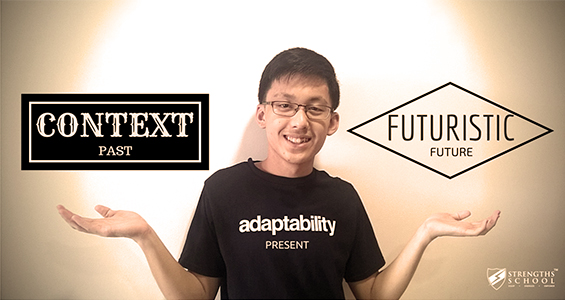
While everyone has a unique combination of strengths in their top 5 CliftonStrengths themes, some combinations come across to me as intriguing and interesting. Singaporean Student, Yu Fung, had a pretty interesting combination of CliftonStrengths themes. This combination caught my eyes because his themes have a time-based characteristic tied to them. Yu Fung has Context, Adaptability and Futuristic in his top 5 CliftonStrengths results. A person with Context enjoys looking into the past to make sense of the future. A person with Adaptability prefer to be in the present and enjoys the "now". A person with Futuristic likes to dream about possibilities that can happen in the future. This was the first time I came across such a unique and interesting combination since I started Strengths-Based coaching in Singapore. To top it up, Yu Fung also had Connectedness in his top 5 CliftonStrengths results.
I had the privilege to interview Yu Fung to understand a little bit more about how he naturally think, feel and behave. The interview is detailed below.
1) Could you share with us the sequence of how you go about making decisions having all 3 talent themes (Context, Adaptability & Futuristic)? If you can, provide an example so that readers can understand.
YF: I tend to find myself making decisions by first thinking of what has already occurred in the past, using "Context" to filter the answers to my question out. Following that, I will think of ways to "repeat" those occurrences from the past in the coming future, using the "Futuristic" trait. After which, I then adjust my current situation and myself to get the desired result I want to see in the future, thus using "Adaptability", and all 3 themes to make decisions. An example of how I make decisions like this would be my goal of studying at Waseda University. Firstly, I did some research on what kind of graduates the University produced in the past. Through the research, I decided that it would be good if I can graduate from this same University in the future, as it had produced influential graduates in the past. After making this decision and having a goal in mind, I used this information to change my subject combination now in the Singapore Junior College that I'm studying at. I decide to change the subject combination to one that I feel will give me the best chance to enrol in that particular University in the future. This is how many of my decisions are made using these three different talent themes.
2) Is there a difference for the sequence when it comes to smaller decisions compared to bigger ones?
YF: Regarding the sequence of talents utilised during choices, I mostly tend to lean towards solely my Adaptability theme when there are quick decisions to be made and I have only a few minutes to make these decisions. I use all the three talent themes of Context, Adaptability and Futuristic mainly when there are large and key decisions.
3) Which talent theme do you resonate with the most and why?
YF: Personally I feel I resonate the most with the Context theme as I really enjoy digging up the past with all its mysteries. I feel the past has a lot of meaning and I enjoy reading about what others have done. I love studying my history subject in school!
4) You're the first person whom I have come across who has all 3 "time factored" talents. How do you feel about this combination?
YF: Haha. I think that these 3 talents I have are quite special in a way to me. Using them is almost second nature to me. Now knowing that I am so unique is really surprising to me. I always thought such thinking is normal. I feel great about this talent theme combination because I really enjoy using these 3 talent themes. It is who I am.
5) How are these 3 talent themes shown when it comes to your studies or school life?
YF: I feel that the Futuristic theme is the one theme I rarely use in school especially in Junior College. Maybe I just need more guidance on how to use this theme effectively. I feel that the Context theme is very much visible due to the plain fact that I take History as a subject. I really enjoy studying about the past. I use my Adaptability theme frequently in my studies as I tend to adjust my study schedules a lot. I enjoy studying in a very dynamic and spontaneous way.
6) Have you taken any leadership role before? If yes, how do you think you use these 3 talents for your leadership role?
YF: I was appointed the head of the Secondary One students in my previous Co-Curricular Activity (CCA) during my senior years in Secondary school. I had to use my Context theme to recreate programs or initiatives that I felt was personally impactful to me in the past, while adapting minor changes to make the planned programs more effective to the students I was leading. I think the fine tuning was the Adaptability theme at work. Of course, the programs are made because my Futuristic believes that the students can grow in the future as a direct or indirect result of the planned program.
7) Do you have any interests/ hobbies/ favourite movies covering 1, 2 or all 3 of the talents?
YF: I do not really have hobbies that cover the Futuristic talent theme, but I do have some for the other 2 themes of Context and Adaptability . I enjoy building scale model replicas of World War II battleships, and am currently still working on one. This is because I deeply enjoy the history of WW2. I also enjoy playing RTS (Real-Time Strategy) games, as they force me to think on my feet and make decisions as and when something happens, using my Adaptability theme.
8) When you think and reflect on your own life, how do these 3 talent themes affect your thought process?
YF: Whenever I reflect on my life, I feel that I tend to follow the ranking of the strengths I have tellingly. I will always start by thinking of what have I done before, then move on to what outcome I desire to accomplish in the future. After that, I will decide on what to do in the present. This is my natural thought process.
YF: Thank you for this interview. I learn a lot about myself as I reflect.
Concluding Thoughts: Some people have very interesting combinations of talent themes in their top 5 StrengthsFinder results. These combinations provide very unique perspectives that can become a great source of strength and power to help a person succeed in what he does.
If you know of someone who you feel has a very unique combination of talent themes, let me know! I'll love to conduct an interview with this person to find out more! Do watch out for part 2 of this StrengthsFinder Theme Combination Series. The next article will explore StrengthsFinder themes tied to the idea of speed.
READ: SPEED-BASED STRENGTHSFINDER THEME COMBINATION
Written by Victor Seet
Activator • Communication • Strategic • Self-Assurance • Command
Discovering Each Other's Best
What happens when a couple sits down together with their CliftonStrengths results and genuinely tries to understand each other's natural talents? Singapore CliftonStrengths coach Victor Seet interviews a couple who did exactly that and shares what they discovered.

As a former Youth Pastor, I have spoken to many young people on a very common topic: how to navigate through challenges in Boy-Girl Relationships (BGR) and courtships. When many young people enter into a courtship or relationship, they are often also in a developmental stage of life and growing in maturity. Navigating through challenges in a courtship often takes a toil emotionally and mentally. Many young people often found out after they enter into such a relationship, that differences in personality can be both a blessing or a snare. Much depends on the ability and maturity to manage these differences.
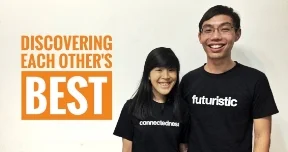
I interviewed a couple, Samuel Lee and Gloria Pang, while they were in the midst of courtship. They were people who actively sought counsel from mentors, surrounded themselves with peers who can offer them encouragements and looked out for tools that can help them strengthen their relationships.
One of the tools that Samuel and Gloria actively use is the CliftonStrengths (formerly Gallup StrengthsFinder) tool. They both believe in using the tool as a a means to discover the best of each another. As they used the CliftonStrengths tool for over a year and actively had different conversations (often deep ones) over each other’s strengths, they experienced different benefits on their relationship. When I invited them to share with others their experiences, they graciously agreed. Before we begin, they will like to add some comments about this interview.
This interview is about how they use the CliftonStrengths tool to grow their relationship. They believe that the tool must be aligned to common values and a commitment and accountability to each other.
This interview is about how they used the CliftonStrengths tool effectively while continuing to leverage other means to strengthen their relationship. The tool remains one of the different means towards their desired outcome of a strong relationship.
Let’s read what they have to say!
1. How do you feel when you first saw each other's top 5?
S: Honestly, I felt slightly discouraged initially because of how different our strengths were like (Hahahaha). It was quite obvious as well because we were both accessing the StrengthsFinder App on our phones and the colours shown were so different! They were just the opposite – Purple and Blue (for Gloria) vs Yellow and Red (for mine). I realized our strengths are in so different domains. After reading through her Strengths descriptions, I realized that the CliftonStrengths tool had come up with a language for me to articulate things about Gloria that I knew intuitively but did not know how to articulate or describe.
G: Daunted! I think I didn’t understand the magnitude of us being created and wired so differently until we talked about it at length on various occasions. While the initial reaction was feeling daunted by the implications, I also believe that there is strength and something exciting about diversity.
2. Out of your partner's top 5 talents, which do you feel often stands out in the relationship and has been a blessing to you?
S: Gloria’s Relator. Definitely. I think her Relator theme is what helps our relationship grow deeper continuously. I often feel like she’s the safest person I can share things, knowing that she values deep sharing. She also responds well to all my sharing because she understands my feelings intuitively without me needing to elaborate much. We often spend hours talking about everything and anything from my work, our pasts or our dreams.
Being her boyfriend, I enjoy her prioritizing our relationship above many of her other important things and it gives me a sense of joy knowing that our connection grows stronger each day. She also gives me a sense of closeness and I have discovered that the way she trusts me has been a really huge blessing.
G: Probably Sam's Futuristic (watch this Futuristic video done by Samuel) and Strategic talent themes! His Futuristic theme means that he thinks and plans for the future as well as paints positive pictures of what the future can look like. His Strategic theme shows him different options and ways to achieve something. So in our relationship, if we feel stuck or might not have a solution to something, his Strategic theme allows him to think of many options and find the best one that will be most beneficial for us.
3. What did you discover about each other after taking the Strengthsfinder assessment that you did not previously know?
S: Hahahaha, I think we both discovered that differences did not mean we would necessarily live in conflict and unhappiness but that we could live complementing each other and enjoying the fruits of having 10 different dominant CliftonStrengths themes!
I began to realize that she was someone who viewed the world rather differently from me through her Responsibility theme. Her description says that driven by her talents she would naturally have high standards for whatever she is tasked with and that she would not rest till she had completed the duty given to her. She also would more than likely say yes to new tasks given to her to perform.
That was something we initially had discussions about because I did not understand why despite her schedule being packed as it was, she would still say yes to doing things for people. We had a good talk about it afterwards. I realized that I need to understand that her heart is to do things for the people she loves. This is something I have gotten used to.
I think one of the takeaways for her was realizing that when I talked about the future, I wasn’t just daydreaming but I was really casting a vision. I love giving hope to people (including her) about what the future could be like. Upon realizing I had the ‘Futuristic’ theme, she started being more open to the future plans I have envisioned and shared with her. Because of my Maximizer and Activator theme as well, she realized that these “future plans” can actually become a real possibility.
G: I guess that we are really truly different? Like the lens through which we view the world can be quite different, as well as the way we process, interpret things, what we think about, what we intrinsically value and are excited or energised by.
4. Which of your talent themes often clash and contribute to the conflicts between the both of you? How did you try to resolve these conflicts?
S: Initially, my Maximizer theme and her Developer theme would clash often and contribute to conflicts. As leaders serving together in our church youth ministry, while I was focused on choosing the best people for a certain role and job, she would often see the opportunity to grow people. At times we would have differences over how we viewed people because of these two themes. Admittedly though, those arguments have helped both our Maximizer and Developer themes mature.
The other way these two themes clashed was in our behaviours. As a Maximizer, I was a lot more impatient with tasks given because I desired to do things the best way and get great results. For her as a Developer, she was rather patient and knew that things needed time and the people we were mentoring needed time to grow and become better at what they are doing.
We resolved these conflicts by firstly acknowledging that no strength was better than the other and we chose to seek to understand each other’s strengths first. After which we would use our other Strengths to help resolve our differences. For example, whenever there was a time crunch, Gloria would realize that by using her Responsibility theme, the right thing to do would be to get the things done quickly. That will align with my Maximizer and Activator themes. However, if we were looking at a long term project, by using my Futuristic theme, I would understand that growing people and being patient with group members or mentees would require time. This will help align me to her Developer theme.
G: Possibly his Maximizer and my Developer! I think his Maximizer theme often compels him to focus on the best or in achieving the best. At times, that makes me feel that our progress or growth in our relationship is insufficient (which is contrary to the lens of the developer talent). At times, I will misunderstand his Maximizer lens and think that he has a constant discontentment with our relationship. That would also imply and made me feel inadequate in this relationship.
5. Which strengths do you think you can intentionally leverage more for the strengthening of this relationship?
S: I think my honest answer would be all the strength we have! But if I have to pick one, I would pick the Strategic theme! In the face of problems and obstacles, I have found that my ability to think outside the box and find alternative solutions helps us to not feel like we are trapped. Through the Strategic theme, I can see the path that would lead us to success and I will discard options that are less useful so that in confusion or crisis, we can still move forward!
G: Relator and Belief themes, I think my Relator theme allows us to build depth in our relationship. My Belief theme helps me by developing new convictions and values in the way I relate to Sam. This can be about relationships in general, or through learning new things about each other in ways that could be powerful. For example, a belief that conflict resolution rather than evasion is important for the relationships allows me to overcome my preference for the latter while honouring Sam’s preference for the former (and an overall strengthening of the relationship).
I think I can harness my Developer theme more as well to move beyond merely recognizing the good and progress in our relationship, to communicating the progress. The communication of our progress can be a source of encouragement and affirmation to the both of us.
6. You went through a CliftonStrengths (StrengthsFinder) workshop session. How did you benefit from the workshop?
S: I think the workshop was particularly enriching because it helped Gloria and I get to know each other more. Often, misunderstandings happen. To help realize that both persons are actually desiring the same outcome, the knowledge of how both persons are wired is essential! As our StrengthsFinder Coach, you provided a safe environment for couples to explore questions and dialogues that helped a lot. One of the things we learnt was our peak experiences (situations that we used all 5 of our dominant strengths for a situation and experienced great success). Hearing Gloria shared about what brought her fulfilment made me realized that I did not understand her CliftonStrengths themes and I had sometimes unintentionally poured cold water on something she was celebrating. That exercise was fun and simple yet deep and insightful! I would highly encourage the CliftonStrengths workshop to all couples!
READ: USING STRENGTHSFINDER FOR MARRIAGE RELATIONSHIPS
G: I think the workshop was not just useful for me to understand my partner, but also to know learn how my strengths can be used to be a blessing to each other! I found the workshop very good!
Concluding thoughts: One of the key reasons why the CliftonStrengths tool worked powerfully for Samuel and Gloria was because of the intentional way they used the tool for conversations. Those conversations helped to steer their relationships towards growth. I hope as you read about the benefits through this simple interview, you too can be personally encouraged and challenged to have deep strengths conversations with your partner.
Contact me if you are interested to find out more about Couple Coaching.
Written by Victor Seet