

Emotional Intelligence with CliftonStrengths
Emotional intelligence and CliftonStrengths are usually treated as separate topics. Singapore Ontological and CliftonStrengths coach Victor Seet explains how the two are deeply connected and how your unique strengths profile can become a practical tool for building greater emotional intelligence.

By Victor Seet, ICF (PCC, ACTC). The world's only coach to hold both the Gallup Gold and Platinum Certified CliftonStrengths Coach awards and also a Newfield Certified ontological coach. Based in Singapore.
As a believer in the strengths-based approach, I have been integrating emotional intelligence with strengths intelligence as I continue my practice into the ontological approach to coaching. It is something I have been experimenting with over the past few years. This article explores how I have been integrating these two areas of human intelligence. Specifically, this article presents how I have used the CliftonStrengths profiling to enhance emotional intelligence.
If you google emotional intelligence, you will come across four components - self-awareness, self-management, social awareness and relationship management. This article explores these four specific components of emotional intelligence.
Self-Awareness
In the context of emotional intelligence, self-awareness is the ability to see how our emotional states affect our daily living, such as our decision-making or our communication with others. It is the ability to know ourselves and understand our feelings.
For example, when we are in an emotional state of anger, we are predisposed to retaliate in words or actions. When we are in an emotional state of curiosity, we are predisposed to ask questions and gain new knowledge and understanding.
CliftonStrengths assessment can help individuals understand the likely emotional habits they might have built over time (albeit subconsciously).
Here are some examples:
1. Individuals with high Responsibility might have developed emotional habits such as anxiety, worry, fear, etc. They are predisposed to feeling burdened because of the responsibilities they carry. In Singapore, some with the Responsibility theme might be called a “kancheong spider” (a term to describe individuals often flustered while dealing with anxiety).
2. Using a combination of two CliftonStrengths themes: Individuals with both the Activator and Achiever primarily focus on getting things started and finishing tasks. They might be predisposed to developing the emotional habit of ambition and perhaps less likely to experience the emotional state of calmness or peace.
3. People with the Maximizer or Restorative are often viewed as “perfectionists”. They are less likely to declare satisfaction with the tasks they have completed. Things are often “not good enough”. They are less likely as well to experience peace.
Our emotional habits are often formed from our instincts to think, feel and behave.
As a coach, I feel that gaining this insight empowers individuals to have the choice of building new emotional habits to expand their human capacity and deepen their level of maturity. This knowledge helps individuals to build deeper self-awareness through the perspective of emotional habits. This knowledge also provides a more comprehensive understanding of themselves.
Self-Management
In the context of emotional intelligence, self-management is the ability to regulate our emotions in different situations and not let our emotions get the better of us. It is emotional regulation and self-control.
With the CliftonStrengths tool, knowing the basement (infancy) and balcony (mature) state of the CliftonStrengths themes empowers individuals to regulate their behaviors and actions. With knowledge of our basement and balcony state, we can more deliberately match our thoughts, feelings, and behaviors to the different situations and contexts for effectiveness. The ability to regulate our behaviors helps us to be more emotionally intelligent.
E.g The basement state of the Harmony theme includes sweeping things under the carpet or keeping silent in the face of questionable behaviors, usually for fear of conflicts. When an individual intentionally regulates his behavior and grows towards a more mature or balcony state of Harmony, it is a hallmark of being emotionally intelligent.
Conversely, not developing the Harmony theme toward maturity might cause long-term negative consequences. As a coach, I often observe resentment surfacing when individuals remain in the basement state of Harmony. This emotional state of resentment often produces more harm for individuals and hinders their ability to do effective self-management.

Social Awareness
In the context of emotional intelligence, social awareness is the ability to identify the emotions of others and use that knowledge to demonstrate empathy, connect with others and be inclusive. It is about how we relate with others, especially with people who are very different. While some view diversity as a fact of life, the idea of “common sense” shows that people expect uniformity in behaviors.
CliftonStrengths helps in two ways.
Firstly, it provides data statistically to show the odds of two persons having the same five themes in the same order is 1 in 33 million. This data has often helped those who are data-driven to embrace the diversity of those they work with.
Secondly, the CliftonStrengths profiles and write-ups provide a language in how people with certain themes think, feel and behave differently. This means that individuals and leaders can now use the strengths language intentionally to relate and interact with others.
For example, a person with the Relator theme often prefers deep conversation in a one-to-one setting. When a leader intentionally sets up regular catch-ups with the Relator, with either party able to propose their agendas for discussions, trust builds up. The CliftonStrengths tool allows leaders to increase their emotional intelligence by customizing approaches that meet the needs of different individuals.
Relationship Management
In the context of emotional intelligence, relationship management is the ability to collaborate, build trust and manage interpersonal conflicts.
The CliftonStrengths tool helps individuals to identify their strengths and blindspots. When individuals do their inner work and uncover these blindspots, they can make more appropriate and productive social decisions in different situations.
For example, individuals with the Deliberative theme see that their unique lens is often that of risk assessment. They will take time to consider the different risks before they act. Making appropriate and productive decisions could include making timely requests to others. In working with others, they might make known their decision-making process and request adequate time and space to make a decision. This process allows them to be better collaborators. It is also a mark of demonstrating high emotional intelligence.
The CliftonStrengths tool also helps individuals manage conflicts by identifying how others think, feel, and need. For example, a frustrated Analytical person might have these thoughts. “Where is the proof? What reliable data do we have? To resolve the potential conflict, we have to understand an Analytical person needs to have different data points that can withstand scrutiny. Meeting the needs of those we work with will help us manage conflicts.
The CliftonStrengths profiles also reveal, through the different themes, how individuals need to tap into specific strengths that enhance emotional intelligence for a particular situation and downplay those that hinder emotional intelligence. When individuals do that intentionally, they can make more situationally appropriate social decisions and moves.
For example, when an individual with both Achiever and Learner questions why a colleague has not completed a given task, the Achiever is usually more judgmental while the Learner is more curious. Tuning up the Learner theme and tuning down the Achiever will probably help this individual make a more appropriate social response.
Ending note: As an ontological practitioner, I embrace the idea that humans perform better when they see their strengths and emotional habits as integrated. I am happy to report that coaching clients have given me feedback that this integrated approach has empowered them to gain clarity of their inner life and has given greater ownership towards transforming their lives.
Written by Victor Seet
Activator • Communication • Strategic • Self-Assurance • Command
Victor is passionate about helping people be better observer of themselves to achieve the results they want, especially in the area of well-being and performance. Victor intentionally integrates the strengths-based and ontological approach into his leadership coaching and workshops.

A Manager's Guide to Leverage The Strengths of the Team
Knowing your team's CliftonStrengths results is one thing. Actively leveraging them as a manager is another. Singapore Ontological and CliftonStrengths coach Victor Seet shares practical ways managers can use strengths awareness to lead their teams more effectively every day.

This article is written to share some coaching practices that I have been helping team leaders and managers with, especially those who are intentionally building a strong team culture. The question that is commonly explored:
What are some practices that you can do as a manager to leverage the strengths of your team?
1. Collect strengths data of the individuals and the entire team
Get some data on each individual’s strengths. Put all the individuals’ results together and attempt to make sense of the team’s overall strengths. This process can be done by using different profiling tools. Some of the profiling tools that focuses on strengths include the CliftonStrengths assessment, the Strengths Profile and VIA Character Survey. Using a profiling tool to assess your team’s strengths give you a common language to assess each individual. This is probably the easiest way to get to know your team strengths.
On a separate note, if you are using CliftonStrengths, the four domains of team or leadership strengths are a powerful way of learning and seeing the collective strengths of the team. You can check out this article I have written:

2. Have a strengths conversation with each individual
During the chat, ask questions like “Where are you at your best at work? What kind of tasks do you love doing the most or find yourself looking forward to? Other than financial returns or recognition, what might motivate and drive you? Which activities do you find yourself volunteering for?
This kind of conversation with your staff is a fantastic way to connect with them. Most staff are tired of managers doing fault-finding. Having a manager who seeks to learn and understand their strengths is simply refreshing!
It’s also worth noting that when an individual shares about a desire to do a particular task, your assessment might be there is a competency gap. This becomes a great opportunity to have a conversation about skills development. This can often exists if the staff is younger and less experienced.
3. Share Your Strengths as a Manager
Your staff comes to you with their proposals and ideas. From this perspective, each individual is expected to engage in some kind of collaborative work with you. As a manager, you evaluate the plans, proposals and ideas using your strengths (“are you aware this is an automatic lens you put on?”).
For more effective team communication, it is useful to share your strengths intentionally with your team. Your staff will appreciate knowing how you will evaluate their proposals. With the knowledge of your strengths, they can prepare themselves for discussions with you. They will also appreciate how they can think about leveraging on your strengths to improve their ideas.

Check out this article: A Manager’s Guide: Using StrengthsFinder in Personal Development
4. GET INPUTS around Your Team Strengths
No manager has all the answers. So why not tap on others’ perspectives? As a manager, you can intentionally set up discussions around your team’s strengths. Invite individual team members to articulate how they see the strengths of the team and get their perspectives. Invite other business leads, HR business partners etc to share their views. The diversity of views presented on the collective strengths of your team can empower you to leverage the team’s strengths more comprehensively.
5. CELEBRATE Contributions
Mark Twain says “really great people make you feel that you, too, can become great”. As a manager, celebrating strengths and contributions are a hallmark of a great manager.
You can intentionally invite individuals to share with the team about “this is what I bring to the team or this is what I can contribute most effectively”. You can also invite the other team members to validate and affirm what has been shared to strengthen the team dynamics.
6. EXPLORE WITH THE TEAM ON HOW TO SUPPORT EACH OTHER
It is intuitive for managers to see how strengths are linked to performances. It is perhaps not so common to see how strengths can be used to create support for others.
Managers can enhance team safety and well-being by facilitating a conversation on how the team can support one another by tapping into each other’s strengths. This can be a discussion around the idea of “where I need help.” The request can be as simple as “I often need ideas. I often need reminders. I often need a listening ear etc”.
This discussion is essentially an exercise on vulnerability and trust. If carried out successfully, this exercise empowers the team to help each other more intentionally. A high performing team develops when team members are mutually supportive of one another. This is an essential team standard to establish when building a strengths-based team culture.
Caveat: Work and strengths come together. Managers need to be able to demonstrate strong clarity about what's the work that needs to be done. When there is great clarity about the work, managers can explore with ease how the team’s strengths can be tapped. Leveraging the team strengths is a combination of knowing the work and knowing the strengths with great details.
Continue Reading — The CliftonStrengths Series:
Want to bring CliftonStrengths into your team? Enquire about a workshop or team coaching program here.
Written by Victor Seet
Activator • Communication • Strategic • Self-Assurance • Command
As a Gallup and Newfield Certified Leadership Coach in Singapore, Victor is passionate about helping people be better observer of themselves to achieve the results they want, especially in the area of well-being and performance. Victor intentionally integrates the strengths-based and ontological approach into his leadership coaching and workshops.

A Manager's Guide to Understanding Emotions and Conversations
Most managers focus on what they say in a conversation. Far fewer pay attention to the emotional mood that surrounds it. Singapore Ontological and CliftonStrengths coach Victor Seet explains why understanding emotions and moods is one of the most underrated leadership skills and how to develop it.

As a male who grew up in Singapore, I bought into a cultural narrative that “guys don’t do emotions”. Most of the male authority in my life hardly expressed their emotions. I was repeatedly taught that emotions can make you commit to decisions that you will regret. I grew up hearing things like “men do not cry; don’t waste time dwelling on your emotions”. The topic of emotions was one I had difficulty grasping. In fact, my entire body reacts when another person starts to tear in front of me. As I was growing up, I was determined to be strong in my mental strength and to control my emotions (mostly by suppressing).
It is now 2022 as I am writing this article. I have since realized that emotions have a profound effect on what I can and cannot achieve in areas of relationships, leadership, work, spirituality etc. If I want to be an effective leader, it is no longer enough to thrive in the “rational zone”. I need to do deeper self-work to understand, experience and learn emotions. This will ultimately increase my effectiveness to create psychological safety, mentor and coach others, listen well, to name a few important leadership competencies.
As I continue to pursue breakthroughs in the domain of emotions, I am hoping to help other leaders (especially male leaders) do the same. This article is written to explore the impact of moods and emotions on conversations. The below points are a combination of my learnings as an ontological coach, a leader, a parent and a father.
Impact of Moods and Emotions on Conversations
1. Language and actions affect emotions.
Our mood and emotion changes when we received good or bad news. I have experienced joy and satisfaction when a client accepts my business proposal. I have experienced sadness when I am listening to stories about friends struggling with cancer or personal loss.
Emotions are embedded in stories we tell others and ourselves. In a digital world overflowing with data, I observed that many managers struggle to see it is the stories (derived from the data) that can move the hearts of the audience. Data and facts cannot create an emotional connection. It is also the stories we tell ourselves that inspire faith and hope or create fear and anxiety within us.
Implication: Storytelling is a skill that managers cannot afford to neglect, especially in the digital world. Telling stories is now akin to communicating purpose and vision. Telling powerful stories create the emotional connection needed for people to be stirred into action. It is true not only for others but ourselves.
2. Moods and emotions are highly predictive of future actions
From a young age, children learnt how to analyze the moods of their parents before they make a request. Intuitively, they are aware that they have a much better chance to get their desired outcomes when their parents are in a good mood.
Philosopher, Humberto Maturana, provides a definition that I personally found to be extremely helpful: emotions and moods are predispositions for action. He observed that according to the mood and emotions we are in, some actions are possible while others are not. For example, if you are in a mood of distrust, the possibilities of coordinating action with another team member are reduced compared to if you are in a mood of gratitude.
Implication: When managers can read the moods and emotions of their teams, they possess a set of data that are highly predictive of the team’s level of engagement, collaboration and trust level. All of these are highly predictive of the team’s performance. Therefore the ability to read and sense the moods and emotions (aka emotional intelligence) can be an important area of leadership development.
3. Creating a shift in the mood brings about new results
If we happen to be in a good mood, the future will look bright and vice versa. Regardless whether the meetings are for brainstorming, coordinating actions or resolving conflicts, managers who can skillfully create a shift in the mood of a conversation to a more uplifting one has a far greater chance of achieving a productive outcome. The ability to create a shift in the emotional state helps a manager to bring about a new of results that are otherwise not possible based on the prevailing mood.
Implication: On top of reading the mood of the team (point 2), facilitating a shift in the mood of a team is an important skill that cannot be ignored. Managers who develop competency in this particular area will become more effective in leading their team.
4. Emotions and moods affect how we listen.
Depending on the moods and emotions we are in, our conversations can look very different because we speak and listen differently. Determining the prevailing mood of a conversation and assessing if the mood sets the required context to achieve the desired conversational outcome is a strategic leadership skill. This skill is particularly powerful for crucial conversations - business presentations, strategic planning, sales negotiations, performance management etc. These are examples of conversations in which managers want to be intentional to frame and prepare listeners to be open and curious to the agenda and the content of the meeting.
Implication: Managers need to pay close attention to the mood and emotions of the participants in crucial conversations. By noticing the emotions, managers get precious data to adapt their approaches for more effective outcomes.

5. Moods are often transparent
A mood can be defined as an emotional habit practiced by a person over a long period of time. It is observed that many people are not aware that they have a “mood”. Moods are often transparent (or invisible) to the individual. We often hear people saying “This is just the way I am and how I do things. Do not expect me to change.” When people do not see that they have a “mood”, they are not able to take responsibility for the mood they have created.
Implication: Managers can coach their team to be aware of the impact of emotions and mood on conversations. By helping others understand that it is the mood that affect our actions, managers can empower team members to take responsibility in how they show up in meetings.
6. Emotions and moods are highly contagious
When we are regularly interacting with people with negative moods, we could expect to soon be in a negative mood ourselves. Most teams usually have one or two individuals who sets the “mood” tone in meetings. These people are the mood-setters. The mood-setters can quickly influence and affect the mood of the entire team positively or negatively by what they say or do. This is because emotions and moods are highly contagious according to neuroscience.
Implication: Managers have to watch closely the moods and emotions of the “mood-setters” in the team. Given their influence, the team’s performance can be elevated or diminished because of how these mood-setters behave. Frequent check-ins especially before important meetings could be helpful. Managers can also be the mood-setter themselves. Managers should develop the habit of checking in with themselves, grow their level of self-awareness and practice self-management. By doing so, they can choose how they want to show up in the team meetings.
7. A team’s mood is representative of the team’s morale
When a team is filled with people who consistently displayed negative emotions, it is highly predictive that the morale on the team will quickly decline if there is no effective intervention. Most managers understand that morale is a crucial factor in overcoming obstacles, winning battles and adapting to organizational changes.
Lifting a team’s morale is more than having team building events or team lunches. Lifting a team’s morale in a sustainable manner is closely connected to deepening the level of trust and care for one another. And building trust and care is dependent on the team’s prevailing mood.
Implication: Recognizing the prevailing mood of a team brings forth an important set of data to a modern manager - understanding and measuring the team’s morale. Managers who believe in creating and sustaining a strong team morale must consider developing their emotional intelligence.
Ending Note: I hope the above 7 points capture succinctly the benefits of understanding the mood of a team and facilitating shifts in team moods. Growing in this area has given me many personal breakthroughs especially in relationships. I hope this short article inspires others to dive deeper in learning about emotions and moods.
Continue Reading:
What Makes Difficult Conversations Difficult? 9 Hidden Fears Explained
A Manager's Guide to Leveraging Your Team's CliftonStrengths
Interested in team coaching for your organisation? Explore Victor's Team Coaching programs here.
Written by Victor Seet
Activator • Communication • Strategic • Self-Assurance • Command
As a Gallup and Newfield Certified Leadership Coach in Singapore, Victor is passionate about helping people be better observer of themselves to achieve the results they want, especially in the area of well-being and performance. Victor intentionally integrates the strengths-based and ontological approach into his leadership coaching and workshops.

Coaching - the Competency Needed to Develop Future Leaders
The demand for coaching in organisations is rising but many leaders still see it as something external consultants do. Singapore ICF PCC Coach Victor Seet makes the case for why coaching is a leadership competency every organisation needs to develop from within.

With the aging workforce, leadership renewal has been a greatly discussed topic for many organizations. As the workforce is slowly populated with Generation Z workers, it is imperative for organizations seeking renewal, to be more prepared by anticipating what the younger generations are seeking.
It is observed that coaching, as a leadership competency, seems well-suited to develop young talent to take on leadership roles. The process of coaching invites self-reflection and self-assessment, which helps individuals grow in personal wisdom and performance for sustained personal effectiveness. Through coaching, the individual is able to apply their self-discovered solutions, and ideas to different situations and contexts they encounter. For this purpose of developing future talent, present leaders should consider the need to develop coaching skills for themselves.
Why Coaching is key to develop Future Leaders?
1. Empowerment is prized over Instruction
The newest member of the workforce, Generation Z, grew up having access to an infinite amount of information. This generation is more used to turning to Google and other social media platforms for answers rather than their managers, teachers or parents. They prefer self-directed learning. They will fact-check against what their parents, teachers and managers have told them. In fact, they might be used to challenging what people in authority says. On top of that, the digital world has also created platforms like YouTube and Tik Tok that allow multitude of voices to be heard. Therefore, the need is learning how to better process and make sense of the immense amount of information that the digital world provides. Growing up with these lenses mean that the new generation of workers preferred not to be told what to do. What this then means is that, this new generation seeks empowerment over instruction.
By using coaching skills in the right situations, leaders can be effective in helping young talent find their own voices. Putting on a coaching hat releases the burden of leaders needing to know all the answers and telling employees what to do. Instead, coaching helps leaders connect with people, partner with them to co-create solutions, and support them to grow. Ultimately, coaching empowers employees to take ownership by challenging people to come up with the answers they require on their own.
2. Wisdom is prized over Knowledge
The conventional way of educating is based on the idea that information is highly inaccessible. The professors and experts are highly respected and revered. In today’s digital world, the new generation of workers are recognizing that more information may not necessarily mean greater wisdom. Knowledge and wisdom are distinct. The new generation sees wisdom as the ability to process information and generate insights. They prized wisdom above being knowledgeable. After all, gaining knowledge is now perceived to just involved googling.
Coaching, on the hand, can distinctly meet the needs of the new generation. The conventional downloading approach thrives on the concept of putting information and knowledge into people; coaching thrives on the idea of drawing out wisdom. The downloading approach sees people as empty containers that need to be filled (an example – giving advice); coaching sees people like a search engine, a good input can draw out and unlock its potential.
To attract and engage talents, it’s imperative that leaders are able to help the young develop wisdom. Considerably coaching is a skill that leaders use to achieve this outcome. They do that by asking the good questions.
3. Listening is prized over Speaking
It is not unreasonable to assess that more people are looking for leaders who can make them feel that they are heard. There are enough data that shows people are wishing that their leaders show more empathy. And listening is a key component to demonstrate empathy. Previously, many might be wishing that their leaders are like Ted speakers who can present data and tell stories in a compelling way. Effective communication is associated with the ability to speak well. We might have undervalued the importance of listening in leadership. Today, in the midst of so much noise, there is a significant shift. The younger generation is wanting less of information and advice-giving. The younger generation is looking for leaders who are willing to listen and empower. In listening, trust is generated and relationships are deepened. Coaching fulfills both the needs of listening and empowering.
As leaders, parents, educators, coaching skills will greatly increase our ability to build and deepen relationships with those we care for.
Invest into the future
Increasingly, more and more organizations are recognizing the need for coaching as a key leadership competency to develop future leaders. It is also undeniable that coaching is perhaps more sustainable and effective in the context of generating trust, enhancing team collaboration, increasing productivity and engaging young talents.
If you are an organization leader reading this, how are you preparing and nurturing your next generation of leaders?
Written by Victor Seet
Activator • Communication • Strategic • Self-Assurance • Command
As a Gallup and Newfield Certified Leadership Coach in Singapore, Victor is passionate about helping people be better observer of themselves to achieve the results they want, especially in the area of well-being and performance. Victor intentionally integrates the strengths-based and ontological approach into his leadership coaching and workshops.
*This article was first written and published for Capelle Consulting.

Listening Through Our Five Senses
Most people think listening is about what you hear. Singapore Ontological and CliftonStrengths coach Victor Seet challenges this assumption, exploring how our five senses each play a role in truly deep listening, and why developing this kind of presence transforms leadership and relationships.
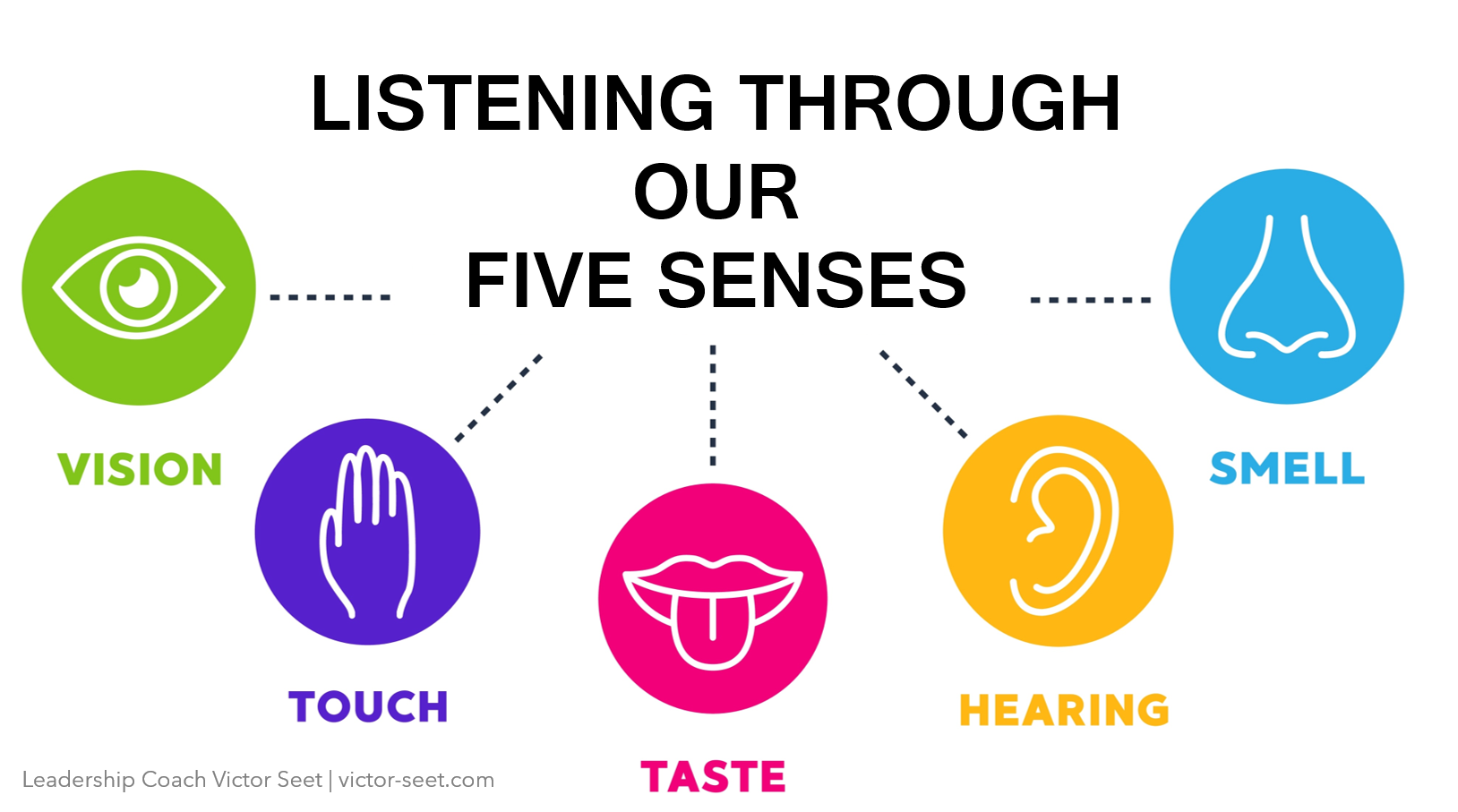
I want to boldly suggest that the digital world has created a shift in the kind of leaders and communicators we need. In this digital world, we are having information overload. There are no lack of great speakers presenting information to us. We have easy access to Ted and videos of great speakers through YouTube. We have easy access to insightful podcasts on Spotify and Podbean. We receive so much information each day from others and that potentially creates a big vacuum - where will we have our voices heard? It is my opinion that as a society, we now desire to have great listeners much more than great speakers because of the need for our voice to feel heard. I anticipate that society as a whole will value a new way of being - a Listener. I wrote about this briefly in an earlier article on dealing with mental health.
This article is written on the premise of growing as a listener. As an ontological coach, I am learning that “we hear with our ears and we listen with our body”. This concept has a profound impact in the way I understand listening. I realized how powerful our five senses (vision, smell, hearing, taste, touch) can help us engage in deeper listening.
Let me provide some examples and practical strategies.
Smell:
When we smell something, our emotional state shift. That impacts our listening. For example, when we smell something foul, we could experience the emotion of disgust or frustration or resentment. When we smell something nice, we could experience the emotion of calmness or curiosity or joy or even playfulness. Many people have turned to aromatherapy and used diffusers to enhance the environments they are in to brighten their emotions and moods. For someone like myself who often engage in conversations in the car, I make sure the interior of my car smells nice by using car scents. The nice smell impacts my emotional state and makes me a better listener.
Given that more and more people are working from home, setting up an environment that smells great can make us better listeners to our stakeholders as well while we are on virtual meetings. Such a strategy to improve effective communication, while seemingly intangible, is worth considering. We cannot control how others speak. We can however enhance our environment to be better listeners.
Vision (Sight)
Listening is powerfully affected by what we see. When we get distracted by what we see, we find it hard to listen. On the flip side, the ability to observe ourselves on virtual platforms like Zoom or MS Teams has provided us with an opportunity to improve our listening. With virtual platforms, we are now able to see ourselves in a mirror-like manner and notice exactly what the other person is seeing. And that is powerful for growing our self awareness. Observing how our expressions change during conversations, noticing our default sitting postures etc, can be very insightful if we want to grow as listeners. Have you notice how you are sitting and presenting yourself on Zoom? How do your audience perceive your attitude, your enthusiasm, your readiness to engage through your body language? The ability to observe ourselves during conversations can be a great game changer.
Hearing (Sound)
We hear what people speak and the tone of voice they use. My assessment is that while many of us might be aware of the language and words we are using in a conversation, the same cannot be said about our tonality. Listening to tonality is a much needed practice if we are to grow in our listening. Our tone of voice are usually invisible to us but visible to other parties. In the past, I received feedback based on my tone but brushed the feedback away by rationalizing “this is just how I am. This is just how I speak!” I have since pay more attention to my tone and volume when I’m speaking. I respectfully encourage us to practice noticing our own tone of voice and the impact our tone has on conversations.
For example, a flat tone could mean someone is disinterested or an emotion of boredom might have emerged. Some tones bring energy and could be closely connected to emotions of enthusiasm or resentment, just to name some examples. When we hear a change in tone of voice, that could also mean a shift in the person’s emotional state and that is an invitation to do a check in. With practice, we can skillfully capture the opportunity to do a check in and elevate our effectiveness as listeners. On another note, the absence of sound and complete silence can create a powerful space for thoughts and emotions to connect during a conversation. Being comfortable with silence is another skill that hones our senses and produce powerful listening.
Taste
Many conversations happen around eating and dining. Many negotiations and important conversations take place around food. The taste of the food has the potential to change our emotional state and change the direction of the conversation.
Consider this scenario:
A waiter showed up with a delicious looking steak. Putting that mouth watering steak into your mouth and tasting it will almost immediately shift your emotions positively. Now add the experience of having a great bottle of wine to go along with the steak, your mood will likely brighten up further. You immediately become a new kind of listener (though this shift might be totally invisible for you).
Now consider another scenario: you took a bite of the fish on your plate only to experience a particular fishy taste lingering in your mouth long after it was consumed. The listening during this particular meal now becomes affected by the emotional state created by the lingering fishy taste.
As a Singaporean who loves to eat, I’m now more aware of how food can change conversations and more intentional to leverage the use of taste when holding important conversations.
Touch
Stroking a pet can bring certain emotions to pet owners and can possibly be a calming influence in conversations. Receiving a tender touch from another human being can evoke lots of powerful emotions as well. Leveraging the power of touch can be very powerful especially for parents with young children. When we communicate that we are listening to our young kids through physical touch, we create a huge amount of psychological safety (this aspect is intangible). As a parent, I’ve lost count of the number of times I have demonstrated that I’m listening to my kids by simply holding their hands, touching their faces, massaging their arms and shoulders etc. I have also learnt to calm my kids down by stroking their arms, stroking their backs, brushing my hands on their hair. This way of communication has worked marvelously for me since I started practicing. Touch is a key listening tool in parenting.
In summary: Have we considered how the global shift to more virtual meetings has amplified the need to listen well? To increase in leadership effectiveness and personal performance, we can practice tuning into our five senses. By paying attention to our senses, we can be more aware of our emotional state and become more effective as listeners.
Continue Reading — The Communication Series:
Want support developing your leadership communication? Explore 1-1 coaching with Victor here.
Written by Victor Seet
Activator • Communication • Strategic • Self-Assurance • Command
As a Gallup and Newfield Certified Leadership Coach in Singapore, Victor is passionate about helping people be better observer of themselves to achieve the results they want, especially in the area of well-being and performance. Victor intentionally integrates the strengths-based and ontological approach into his leadership coaching and workshops.

Listening Through Our Mood
We don't listen with our ears alone. We listen through our mood and the stories our mood generates can completely distort what we actually hear. Singapore Ontological and CliftonStrengths coach Victor Seet explains this overlooked dimension of listening and what it means for leaders and relationships.

Have you considered how the global shift to more virtual meetings has amplified the need to listen well? In an earlier article, I wrote about practicing a new way of being in this digital world - being a Listener. There is a growing need to be more self-aware. That is my assessment as an ontological coach.
Being more aware gives us a greater insight into the choices that we have. The awareness impacts the relational and leadership results we want in this digital world. This article is written based on this premise.
As human beings, we are always listening to emotions. Traditionally, listening is a lot about what others say or do not say and being attentive to how others might feel. To grow our listening, we focus on improving our listening skills to be more effective. These skills include summarizing what was said, maintaining eye contact, asking good questions, etc.
listening through our emotions
Are we aware that we are not only listening to emotions but also THROUGH your emotions? This is the distinction that I hope to offer. We are always listening THROUGH our emotions and mood. We are always in a mood. This mood is, however, invisible to many.
Think of a mood as an emotional habit you have picked up. Let me share an example. Every weekday morning, I wake up at 6 am. I get myself washed up, change and get ready for the day. At 630 am, I wake my three young kids up. I get them to wash up, change into their school uniforms and finish breakfast by 715am. By 715am, the school bus fetches my two younger kids while I walk my eldest to school. What is invisible to me is that each morning I practiced an emotional habit - a mood of resentment. I resent that I used a lot of energy to drag my kids out of bed. I resent that I have to nag at them to wash up and get changed. I resent that I have to rush them to finish breakfast so they will not be late for school. Once in a while, I snapped at them. While I usually feel bad, I often deal with my guilt by rationalizing that my kids are great at triggering all my wrong buttons. In short, I blame my kids (a behaviour strongly connected to the mood of resentment)
The epiphany - swimming in a mood of resentment
I had an epiphany when I learned through my ontological coaching course that we are always in a mood that is usually invisible. From 6-715am, I am in the same mood every weekday. I swim in a pool of resentment during this period. That was the emotional habit I have practiced every day. In this pool of resentment, there are lots of stories and assessments. Each action by my wife or kids triggers a particular kind of assessment. For example, when I see my kid struggling to get out of bed, imagery of a lazy, ill-disciplined kid forms in my head. With my resentment mood, my assessments are pre-disposed to be negative. I am pre-disposed during 6-715am to be an angry, impatient, anxious, irritated father and husband. In my mood of resentment, all I can hear are noises. If I want to be a loving husband and father, I will need a new emotional habit.
our mood pre-disposed us to listen in a particular way
Are we aware we are in a particular mood (or practiced emotional habit) at work? Are we aware that our mood can change when our boss speaks? Are we aware that our ability to trust others is dependent on our mood? Different kinds of stories and assessments are generated in our heads when we are in different moods. These stories strongly affect the way we listen to others. That affects our relational and leadership results.
Here are some questions to develop our leadership and listening competency:
Are we aware of our moods and emotions?
Are we owning and engaging our emotions to be better listeners?
Are we aware that we can shift our emotions to listen more effectively?
Pause for a moment:
What mood are you in as you are reading this article?
I propose that your mood and emotions affect what you are taking or not taking away from what you are reading.
As you are reading this article, you could be winding down from a long day and feeling relieved. You could be ready to start a brand new day and feel hopeful. You could be feeling curious and in a learning zone. You could be feeling bored. How you feel determines what you take away as you read this article.
Listening through our emotions starts with the practice of noticing how we are feeling. That involves checking in with ourselves using these simple questions:
What emotion or emotions am I having right now?
Why are these emotions there?
What are the emotions telling me?
If I am in a contrasting mood (name it), how will I be looking at things?
Ending note: When we practice noticing our emotions, we can learn to become better listeners. When we noticed that our mood does not align with the results we want to create, we can choose to change our mood. Learning to change our mood requires practice. It starts by noticing our mood when we are in different situations. For now, let us conclude that listening is an art.
Continue Reading — The Communication Series:
Want support developing your communication and leadership? Explore 1-1 coaching with Victor here.
Written by Victor Seet
Activator • Communication • Strategic • Self-Assurance • Command
As a Gallup and Newfield Certified Leadership Coach in Singapore, Victor is passionate about helping people be better observer of themselves to achieve the results they want, especially in the area of well-being and performance. Victor intentionally integrates the strengths-based and ontological approach into his leadership coaching and workshops.

13 Principles of Creative Leadership
Creative people often have the ideas but struggle with the influence. Singapore Ontological and CliftonStrengths coach Victor Seet shares 13 principles that help creative individuals exercise real leadership, not by becoming someone they're not, but by leading from their natural strengths.

I have been pondering a lot recently about creativity and innovation. How can we differentiate creative individuals who are good and those who are great?
Perhaps one way of examining is to look at a person's Creative Leadership.
How do I define Creative Leadership? There are many who are creative but not every creative person possesses leadership qualities. Many creative people often face challenges of having their imaginative ideas knocked down by others. It is never easy to have people buying in to a fresh and innovative idea which is more likely than not, unproven. Many creative people give up when they face setbacks. Those with Creative Leadership do not. Those with Creative Leadership influence with their ideas. They find different ways to get others to buy into their innovations. They are highly resilient. They have guiding principles and beliefs that help them overcome challenges and drive innovation. When no one believes in their innovative ways and ideas, those with Creative Leadership have these guiding principles and beliefs as anchors that motivate them to stay on the cutting edge.
Can Creative Leadership be learned? I believe it can be.
I was inspired by some simple but powerful creative leadership principles from a book by the influential Paul Arden. That book got me to think about how people can grow their Creative Leadership by intentionally engaging different strengths in a connected fashion. In CliftonStrengths or StrengthsFinder lingo, the interaction between different strengths is called Theme Dynamics.
Inspired by the book, I connected 13 Creative Leadership principles I have learnt (over the years and through the book) to different CliftonStrengths Theme Dynamics, using the Ideation theme as an anchor. There is also an application question for each of the principles (I'm an Activator). While it is true that each of the 34 CliftonStrengths themes can be used to contribute in the area of creativity, I have chosen the Ideation theme as the anchor for an obvious reason - many people who are known to be creative and innovative have the CliftonStrengths Ideation theme in their top 5 or dominant CliftonStrengths themes. They are full of imagination.
How can those with Ideation grow in their Creative Leadership?
Principle 1: My vision is the greatest creative asset I have.
Ideation and Futuristic: As an Inventor and Creator, my vision is the greatest asset I have. I can dream about that one idea that can break new grounds. I can dream about the product or service I can create that will change the world. I can dream about the positive culture that I can create. The people who succeeded believe in a world that can be co-created. They believe in a world of possibilities when others do not dare to dream.
Application: What ideas can I act on now and what new ideas do I need to move towards my vision?
Principle 2: Aim for the unachievable!
Ideation and Achiever: As a creative individual, I need to aim beyond what I am capable of. I need to develop a complete disregard for where others say my abilities end. I need to develop great ideas and ways to do the things I feel I might be incapable of. It is no longer good enough to create better products or better processes. I need to be the disruptor of industries. Nothing is impossible.
Application: What is one achievement I deeply desire and how can I disrupt myself to achieve what might seem impossible?
Principle 3: My innovations are cutting edge.
Ideation and Self-Assurance: The fact is that the cleverest people in school are not necessarily those who achieve success in life. I can be confident of my creative abilities and the innovation I bring to any team. I am confident in taking risks. The creativity I possess can break through many boundaries and barriers. Entrepreneur or intrapreneur, I can be the Creative Pioneering Leader whose innovations will be cutting edge.
Application: What is one area that I can pioneer or a new ground I can break into using my innovative ideas?
Principle 4. Seek feedback (and embrace criticisms).
Ideation and Input: As a creative person seeking for excellence, I need to be open to feedback and criticism and having people tell me what's the problem. When I accept criticism, I am more likely to get improvements on my ideas. I am still in a position to reject the criticism if I think it's wrong. Creative Leaders exercise humility.
Application: Who can I get feedback from to grow and refine my ideas?
Principle 5: Take extreme ownership
Ideation and Responsibility: I must imagine I’m a Navy Seal. I'm fighting at the front line. There is no time to play the blame game. Whenever a problem arises, I must accept full responsibility even if I'm only partially involved. By doing this, I'm always in a position to do something to resolve any issues and I can make a positive difference. Creative Leaders must have extreme ownership.
Application: What issues do I need to start owning so that I can drive solutions and implement ideas?
Principle 6: Give away everything I know!
Ideation & Command: Many remarkable leaders are generous givers. On the contrary, there are leaders who hoard ideas and are fearful of their ideas being stolen. I cannot be a hoarder. The problem with hoarding is that I end up living off my reserves and soon I'll become stale. I must learn to give away my ideas! It takes courage to do that but eventually more will come back to me. Giving away forces me to look, to be aware, to replenish. Clarity comes from an uncluttered mind. Eventually, I will train myself to be sharper than those who simply take ideas from others.
Application: Who can I share my ideas with so that my innovations can reach more people?
Principle 7: Act on the opportunity you have now!
Ideation and Activator: I must make use of the opportunity I have now to contribute my creativity. The opportunity is right here. I don't need to look for the best one. I can make full use of the opportunities I have now and make the best I can towards contributing creatively. The results might not always be great but at least I will get the satisfaction of trying out my ideas. Over time, I will gain the experience of knowing what kind of opportunities I can grab and what kind of ideas I can easily implement to have quick wins. That will help me mature as a Creative Leader. Gaining a quick momentum is a critical way to pull apart from competition.
Application: What is one area of opportunity that I can see which allows me to use my creative ideas? Who can I offer my creativity to?
Principle 8: Don't take "NO" for an answer!
Ideation and Strategic: I need to keep pushing through for a YES. I need to find alternatives. I need to find a path that will bring a YES! I need to have a resilient mindset and keep exploring new grounds to advance forward. When people say it can't be done, I need to do it. If I don't do it, it doesn't exist. I will be known to be the kind of Creative Leader who creates a path towards success.
Application: What areas do I need to exercise my out-of-the-box thinking and strategies towards to get the results I want?
Principle 9: Failures can give birth to great ideas!
Ideation and Learner: I can learn a lot from my failures and I need to get used to not getting it right. To hone my creative skills is to pick myself up and to learn from every experience. I must intentionally learn from others as well. I can brainstorm better ideas because I grew smarter and wiser. Creative Leaders bounce back up to produce even greater innovations. I will be the Creative Leader who broke through because I never gave up learning.
Application: What is an area of learning that can propel me to be better at brainstorming ideas and create innovative solutions?
Principle 10: Don’t just give a speech. Put on a show!

Forget double shot. Strengths Mug makes your coffee strong!
Ideation and Communication: I must accentuate the positive. I can dramatize what is right. Wow a crowd and bring in the positive emotions. Exaggerate an action. Ideas are often captured by the fresh emotions presented in captivating ways and often through stories! I will be the Creative Marketing Leader who can sell ice to eskimos.
Application: What is one idea I can talk about and what stories can I tell to catch people’s attention and make it stick?
Principle 11: Work with the Best (even if they are weirdos)
Ideation and Maximizer: I need to work with the best creative people. Sometimes they might be difficult to work with but most of these people have excellent qualities that I can learn from. And the fact is, it's probably better than working with Mr Average Nice Guy. Iron sharpens iron.
Application: Who is one creative person I can reach out to have a brainstorming session?
Principle 12: Be a Legend!
Ideation and Significance: Most of us want to work for great companies and great teams. Start thinking and behaving like a winner. I need to stop expecting my managers to lead the way. They are too busy trying to run the company. I need to decide that I'm going to make the company great or at least make a difference. Many companies and great teams are usually built on one or two persons. I must be that person or one of them.
Application: How can I create a legacy in my company through my innovations? Where are the areas within the company that I can offer my creative energy to?
Principle 13: 'ASTONISH ME!’
Ideation and Individualization: Make people feel special! It is about the end user. It is about the individual. Products that are highly customized to fit the uniqueness of the human race catch the consumers by surprise.
Application: How can my ideas be so highly customized that they will have the WOW factor?
Concluding Thoughts: When we leverage our different strengths and engage them in a connected way intentionally, we produce a greater performance. Creative leaders do that regularly and produce consistent outstanding innovations. When they face setbacks, they overcome their challenges by intentionally engaging their different strengths.
"How can you intentionally engage your strengths to drive innovations today?"
Written by Victor Seet
Activator • Communication • Strategic • Self-Assurance • Command
As a Gallup and Newfield Certified Leadership Coach in Singapore, Victor is passionate about helping people be better observer of themselves to achieve the results they want, especially in the area of well-being and performance. Victor intentionally integrates the strengths-based and ontological approach into his leadership coaching and workshops.

Dealing with Mental Health - are we listening?
Mental health conversations are increasing but are we actually listening? Singapore ontological coach Victor Seet shares why genuine listening may be one of the most important responses to the mental health challenges facing individuals, workplaces, and communities in Singapore today.

As Singaporeans, we have been grieving because of the death of a young boy and the nature of the event. I had a recent dialogue with my colleagues to discuss about mental and emotional health struggles. This article is written as a result of that dialogue as well as seeing more and more requests for ontological coaching. I have seen an increase in people asking for help to deal with a drop in work performance. Many of the underlying struggles are related to mental and emotional health challenges.
I will start off by sharing a few personal observations on why, as a society, we might be struggling to address mental and emotional health challenges. I will end by proposing an idea for you, as a reader, to consider.
Why we might be struggling to deal with mental health issues?
Five Observations:
1. We are asked to focus on “ME”.
It’s a strong habit we have built into our human system over centuries. It is plausible that the beginning of the IPhone generation played up the emphasis on the “I” and the “ME”. While this emphasis promotes personal agency, this emphasis also promotes loneliness, especially in times of pain. Ask around. How many of those who are suffering, struggle to ask for help?
Community building, team building, “WE”-building have all suffered in recent years because we are not encouraged to, not used to or asked to think beyond something greater, larger than the “I” and the “ME”. Support for people with mental and emotional health challenges are limited to the professionals rather than the surrounding community. We build systems, processes, apps to try to solve these issues but how are we building the community? The single most powerful asset to community building, team building and “WE”-building is the family unit. What is happening within a typical family unit in Singapore?
2. We are asked to ignore our emotions.
“Leave your emotions at the door” is a corporate culture many employees have experienced. A way to get a quick indication of your company’s culture is to answer this question with honesty: “How safe do you feel to let down your tears in front of your boss or colleagues?” Creating psychological safety in workplaces is seen as a big challenge whenever employees are not given permission to express their emotions.
3. We are asked to be efficient.
We want instant solutions. We want things fast and now. We want sound bites. Pain and grief, however, can be long drawn. Pain does not magically disappear overnight. Certainly, no one has found an “efficient” way to deal with pain. In Singapore, we are products of our system. As a nation, we are 56 years old at the time of this writing. We possibly need to build new skill sets to complement our efficiency.
4. We are asked to believe technology is the answer to everything in a digital world.
Artificial Intelligence is filling up our world very quickly. From customer service to phone applications to investments to learning solutions to driverless cars, we are experiencing a wave of digital transformation. The message perceived by the world is that technology will be the answer to all our productivity challenges. But try telling someone in pain to talk to AI or a robot. Tell these people they will feel better magically after downloading a special app and using it. For all the wonders of technology, there are certain challenges only humans can intervene. It is time to learn that mental and emotional health challenges are byproducts of a digital world. We have not focused on challenges only humans can intervene.
5. We are asked to pursue “happiness”.
“Be the best version of yourself. Be happy. Fulfill your potential.”
It is possible that this single-minded pursuit of happiness has crippled our ability to do sense making and to make meaning of pain. The pandemic has certainly created pain. The pandemic has also certainly helped people to see what true leadership looks like. We have greatly respected leaders who went through immense pain and sufferings yet lead courageously, with compassion and with empathy - “Nelson Mandela, Mother Theresa, Martin Luther King Jr etc”, just to name a few. I believe the capacity to make sense of pain and suffering is a pre-requisite to lead with courage, compassion and empathy. Those who truly lead courageously, with compassion and empathy shine in a digital world.
A new way of being - listening
Traditionally, society values certain ways of being - a communicator, a visionary, a strategist, an achiever, just to name a few. These ways of being embody certain habits, behaviors, mindsets and thinking patterns. For example, a person who embodies the way of an Achiever thinks about goals and tasks, develop habits of productivity and efficiency, works hard and in long spurts, sees success as achievements etc.
I am proposing a new way of BEING that we, especially those of us who are leaders, might want to consider growing into - BEING A LISTENER.
Being and growing as a listener is counter-intuitive in our current culture. Let’s correlate listening with the five points I have listed.
An effective listener has to be less “me”-centred and more “we”-centred.
An effective listener listens to the emotions and what is often unsaid.
An effective listener takes time to do the listening work. Efficiency does not exist in the space of listening.
An effective listener has to be a human being and has to connect emotionally. Listening cannot be done effectively by AI.
Last but not least, without listening, there is no sense-making in times of pain. Listening takes courage. Listening and compassion goes hand in hand. Listening conveys empathy.
Being a listener is more than the skills. It is a new way of being that requires practice and needs to be embodied. It’s like riding a bicycle. You practice till your body “gets it”. It is more than a mindset change. It is more than gaining knowledge. It involves becoming a new “You”.

Ending note: It’s human to be in pain. It’s human to want to feel cared for. It’s human to experience fear and anxiety. When we are in pain, we often want a listening ear. We want our pain and suffering to be validated. We don’t want to be fixed. I am no different. I get a sense that people with mental and emotional health challenges often feel lonely because society sees them as problems to be fixed rather than people to be loved. Listening is underrated. Perhaps it’s time for a change.
Written by Victor Seet
Activator • Communication • Strategic • Self-Assurance • Command
As a Gallup and Newfield Certified Leadership Coach in Singapore, Victor is passionate about helping people be better observer of themselves to achieve the results they want, especially in the area of well-being and performance. Victor intentionally integrates the strengths-based and ontological approach into his leadership coaching and workshops.

Listening is Harder than Hard
Do you struggle to be a good listener? Singapore Ontological and CliftonStrengths coach Victor Seet shares about his journey of learning to listen and highlights the power of noticing to bring forth a real change.

“Harder than hard” - I borrowed this phrase used to describe the highest difficulty level found in some computer games. I chose this phrase to depict the journey that I have been taking in the domain of listening.
I’m a recovering advice-giving addict. Over the years, these are the feedback I have received: “Talk too much; dominate conversations; self-centered; impatient; too much advice; like to interrupt; opinionated; judgemental; want to have the last say”.
I’m a beginner at listening. I declared myself as a beginner the day I made a decision to re-orientate my life. I declared that not listening has caused me pain in too many areas of my life and I had enough. That was in the middle of 2019.
Before I declared this breakdown in my listening, I have read many articles, listened to many podcasts that described the importance of listening. The resources contained many tips and advice. I have tried to apply what I have learnt but I did not get the results I wanted. As I reflected back, learning listening skills without a mindset shift proved to be futile for me. When I declared my breakdown, it felt like an invisible wall had come down. I felt different. I felt a shift.
If powerful listening is at the “harder than hard” level, I’m happy to declare that I’m still at the “beginner” level. I hope I will continue to make progress. There is no shame in that. This article was written because I really wanted to capture my thoughts, record them down and reflect on what it feels like at the “beginner” level.
The very first thing that I had decided to do after declaring my breakdown was to start noticing my own impulses, instincts and my behavior while listening to others. This was the process of collecting data.
These were a few things I had observed.
I noticed that I have a great desire to make offers in almost every single conversation. I offer my stories. I offer my advice. I offer my perspectives. I offer my thoughts of the day. I offer my opinions on things. This impulse to offer was very strong. As I intentionally notice my behaviour and impulses, I found it amusing that I love to make offers. I want to state that I think there’s nothing wrong in wanting to make offers. Noticing this impulse created in me a curiosity about how this might affect my ability to listen..
I noticed I have a particular thinking pattern. I might have a belief that speaking was more valuable than listening. My instincts flushed out this belief. I pay lots of attention to how I speak, how I come across to others when I speak, how to tell stories that would capture attention etc. By contrast, there was little concern about how I come across as a listener. I feel anxious if I assess that I might struggle to speak well or speak clearly on what I hope to communicate. I feel frustrated when I messed up my speech. I feel delighted when I am able to persuade and convince others to buy in to my ideas and strategies. There was however no emotional connection to how I perform as a listener.
I noticed that I listen to speak up. I listen for the space to say something. I listen to respond and offer opinions on things I disagree with. I listen for opportunities to make offers (advice, perspectives, ideas etc). I listen to feel validated about my thoughts. In short, I listen for ME. Listening to care for someone is totally counter-intuitive for me.
I noticed that as I practice listening, the internal conversation (thoughts in my head) is usually louder than the external conversation taking place. It was something I know in the past but I had little awareness of the intensity. The realization that I was quite self-centered became more apparent. The conversation I instinctively focus on was usually the conversation with myself happening in the head.
I noticed as I practice listening, I became more aware of my default sitting posture. I was usually sitting in a more forward leaning position (as if I’m getting ready to pounce on any opportunity given). And I notice that when I form a thought in my head and have an advice or an offer I was ready to make, I lean forward even more. I notice my body is contracted when I listen. I have a tendency to fold my arms as well.
I noticed as I practice listening, I became more aware of my default listening filters. They were usually in certain categories and my CliftonStrengths (or Gallup StrengthsFinder) themes were very helpful to gave me clues. I had the “black or white” filters (Command theme), the “right or wrong” filter (Belief theme), the “efficiency” filter (Strategic theme) just to name a few. As I listen through these filters, my internal thoughts start to form opinions and judgements.
So what did I learn about noticing?
Noticing brought me clarity. The data points gathered were compelling. The more I saw “myself”, the more I could see the new habits and impulses I will need to develop in order to be a new person, a new kind of listener.
Noticing created some kind of latent energy within me. A quick Google search - “the latent internal energy of a system is defined as the internal energy a system requires to undergo a phase transition”. As I took greater notice of my own impulses and behaviours, I also felt a stronger and stronger desire to change. Noticing was producing in me a greater amount of inner strength to make a real change.
Noticing brought discomfort. I lost count of the number of times I felt discouraged and defeated (how come I am so bad at listening?). I have to keep reminding myself that I need to be kind to myself. I have practiced efficiency for a long period but change is slow and often uncomfortable. To be able to sit in discomfort is a capacity I needed to build to create sustainable change in my own life.
Ending note: Some might say noticing feels like inaction. For me, what I took away was that noticing prepared me deeply and powerfully towards the shift - a new kind of person that I say I want to become.
Continue Reading — The Communication Series:
Want support developing your communication and leadership? Explore 1-1 coaching with Victor here.
Written by Victor Seet
Activator • Communication • Strategic • Self-Assurance • Command
As a Gallup and Newfield Certified Leadership Coach in Singapore, Victor is passionate about helping people be better observer of themselves to achieve the results they want, especially in the area of well-being and performance. Victor intentionally integrates the strengths-based and ontological approach into his leadership coaching and workshops.