

What is My Health Worth?
Having issues with high blood pressure? Aiming to lose weight? I finally achieved what I could not do in 20 years. This is a story about getting my physical health in shape.

My last article was about dealing with my emotional health. This article is about the process of getting myself into physical shape.
In slightly over 4 months, I managed to bring my weight down from 80KG to 67KG. It was the first time in the last 20 years that I had managed to achieve my ideal weight and I was pleasantly surprised at the result! For 20 years, my weight has never gone below 75KG. Physical health was never a priority for me and there was no existing system or discipline to look after my physical body. Here’s my story:
A Visit to the Doctor
Through a visit to the doctor in June 2019, I discovered that I had severe hypertension. Several readings of my blood pressure were taken, with the highest reading being a massive 190/110. This discovery was a shock to me. It was a shock to my family as well as I did not have any prior medical history in this area. I suspected that the high level of stress at work was a key contributing factor. Before this discovery, I had taken my physical health for granted. I ate what I wanted and paid little attention to my diet. There was also no attempt to participate in any form of regular exercise. I often worked late into the night and I struggled to sleep well. I also experienced a recurring back pain and a stiff back. This meant that there were times where I had to sit on the bed for a few minutes after waking up because my back was too painful. Despite these issues, there wasn’t any personal conviction to watch my health closely.
Enrolling in a Weight Management Program
After my visit to the doctor, I was certain of one thing: my lifestyle needed to change. I did not want my physical health to suffer further. My blood pressure was a big warning sign. I certainly did not want my wife to be a widow and my kids to be fatherless. As I shared in the previous article, I made the decision to leave my company and to stop what I was doing. I felt that the severe hypertension affirmed my decision to leave. I needed to get my physical health back in shape and time away from work was critical. To bring down my blood pressure in a sustainable way, I was recommended to reduce my weight and watch my diet. I enrolled in a 6 months long weight management program at Khoo Teck Puat Hospital. As you now know, the weight loss was a success. My blood pressure also came under control and no longer causes me stress. Amazingly, my recurring back pain also disappeared! I suspected my weight loss was a contributing factor and I am very happy with the overall outcome.

A Contrast: Before the weight management program and after
How did I manage this change?
Upon reflection, I believe that part of the success was due to intentionally applying some lessons learnt from this book: “Switch – How to change things when change is hard" by Chip and Dan Heath. There were four principles from the book that stuck with me. In sharing my story, I hope it can motivate those who might be in similar situations to achieve change. For a greater understanding of the principles, I highly recommend that you read the book. (And in case you are wondering: I do not receive any monetary benefits from sharing about this book).
1. Find the bright spots:
This refers to leveraging what we already have and looking for what’s already working. For me, losing 13KG felt impossible but thankfully, the dietician from Khoo Teck Puat Hospital was a great help. I was pleasantly surprised that I did not have to go on a painfully restrictive and unhappy diet, like I imagined I would have to do. On the contrary, I realized that I could continue to enjoy food that I loved and keep to 3 meals a day. That was a bright spot.
I also wrote down a list of things or “bright spots” that were already true and empower me towards my goal of losing weight and lowering my blood pressure.
I’m motivated to lose weight for my family
I have a supportive wife. She is my greatest cheerleader
I love swimming and I can create an exercise regime in this area
I used to be a competitive swimmer when I was young. I can easily swim 20 laps or more
I have easy access to an Olympic size swimming pool nearby my place
I own an Apple Watch that can help me count laps
I have no desire for sweet drinks.
I can continue to drink coffee and I am able to drink coffee without sugar
I can eat my favourite food ONCE every week (this sounds great!)
I have little desire to snack
I am not tempted by ramen or baked rice (unhealthy food options)
I love fish soup (healthier choice)
I love Chinese style cooked green vegetables and I can eat lots of them (vegetables help to make a person feel full from a meal)
I have a weighing machine at home and I can closely monitor my progress
I have some good looking shirts that I will love to be able to squeeze into
The above list motivated me into action.
2. Script the Critical Moves
This refers to having clear and specific steps needed to reach the goals. For example, for a healthier diet, go for less or no sugar in coffee or drinks; use skimmed milk instead of full cream milk. To script the right critical moves, it is also necessary to first gather the right data.
One critical data point: The main bulk of weight loss (70% of the time) comes from a changed diet instead of exercise. Therefore, I needed to make a change to my diet to be successful. I found out from my dietician that FRUITS were a main source of weight gain for me. I love fruits and fruit juice. I had the idea that fruits were much better options to chips and fries, while fruit juice was better than bubble tea. I was WRONG in this aspect. Another helpful data point was that I could lose 0.5KG weekly if I kept my daily intake to 1500 kcal (this data is specific to my height and weight).
Using these specific data points, I scripted down my critical moves to reach my goal:
Take 2 fruit servings a day (I was taking 8 servings daily previously). Have a green kiwi / green apple / pear for lunch. Do the same for dinner
Stop drinking vending machine fresh orange juice (1 cup is equivalent to 4 serving of fruits)
Finish my large water bottle of water by noon every day. Refill and finish another bottle by evening
Swim 30 laps every Monday, Wednesday and Friday
Measure my blood pressure twice a day: in the morning and evening
Measure my weight every Monday morning
Use the Health Promotion Board (HPB) app to track my calories intake and find the combination of tasty meals that can hit the 1500kcal daily diet
Have one cheat meal (regular size portion) for Saturday and one for Sunday. Rest of the 19 meals will be kept strictly to the recommended options given by dietician
Read: “The Power of Naming An Emotion”
3. Point to the destination.
This refers to having a compelling picture and being clear of the measurable end goal. It is about imagining how success can benefit me and others.
My Measurable Goal: My aim was to bring my blood pressure under control by losing weight. My blood pressure needed to be below 140/90 and my ideal weight was 67KG. That was my end goal for the 6 months.
The Compelling Picture: I imagined the picture of my family spending quality time together. Without me being in good health, this might not be a possibility. I also imagined the extra energy gained from growing stronger due to exercise, which would allow me to play more effectively with my 3 young kids. I also imagined feeling much happier looking at the mirror: without a belly and with a sharper chin. I look forward to being fitter and healthier. I imagined having a sharper mind and having a greater ability to focus. which would expand my mental prowess which is important for me.
4. Shrink the change
The idea is as follows: If you want to motivate a reluctant elephant, you got to lower the bar, NOT raise the bar. Small emotional victories also bring more lasting changes! When a task feels too big, the reluctant elephant will resist.
For 20 years, I had no success in weight loss.To lower the bar, I bought new goggles and swim gear to make myself happy. I researched and found the swimming pool that had all the attributes I wanted - close to my place, not crowded and with good bathing facilities. I also worked out a morning routine that gave me 1.5 hours to swim and shower. I was ready to swim!
I started joining my wife and 3 kids in eating baby oats for breakfast. Eating together was emotionally helpful. I eventually got used to eating oats which was not only healthy, but also lowered blood pressure. I also stopped drinking fruit juice. I drank coffee or water instead. I also found an alternative drink with zero calories: Ayataka Green Tea!
My small emotional victories after the first month:
I aimed to lose 2KG but I lost 3KG.
My blood pressure stabilised and remained around the range of 125/85.
With this, I started to believe that I could do it. I implemented my new diet progressively. The HPB app allowed me to input the local Singaporean dishes with the required calories data attached to the food. What I did was simply to log all the food I have eaten and monitor the total amount by the end of the day. By being able to experiment and adjust my food intake daily, I soon found the combination of food that allowed me to reach my 1500kcal a day target.
Eventually, I started to achieve more emotional victories such as wearing M sized t-shirts instead of L size. My pants became looser. I started to get compliments and encouragements from friends and I finally hit my goal.
Conclusion: “What is my health worth?” This is a question that I had pondered when I was working hard at getting my health in order. I have never prioritised my physical health but that has changed. I have since gained a new perspective on the benefits of healthy living. I continue to swim 3 times a week and I now make it a point to eat healthily. This has made me happier. I used to wear L sized male t-shirts and I can now wear S size! I hope my story has shown that aiming for a weight loss is achievable and definitely not as torturous as it seems.
Written by Victor Seet

The Power of Naming An Emotion
We can only intervene in what we can see. This article is about how the process of therapy had helped to give a name to an emotion which had troubled the writer. That empowered him and brought a change in his marriage.

In the middle of 2019, I took a sabbatical from my coaching work and left my company. One of the main factors behind my decision was the state of my emotional health. At the start of 2019, I had several indications that I was already not doing well emotionally. There were several incidents where I had allowed rage to get the better of me. These emotional outbursts happened at home and at work. However, I told myself that this was a normal phase in life. After all, I was living in a fast-paced and competitive society in Singapore, living a stressful life as an entrepreneur and being a father to 3 young kids.
The Tipping Point
However, by mid 2019, I had to stop telling myself the same narrative. The tipping point was a particular episode I had after a team debrief. As a company, we had just completed our largest training project - in terms of revenue and the number of training participants. The project was especially remarkable because it was birthed out of an innovation. There was no template, no previous experience of such kind and the team pulled it off. To top it off, the feedback from the participants was fantastic. The debrief was intended to celebrate this huge success and to brainstorm ways to overcome operational challenges. Unfortunately, the debrief did not turn out the way I hoped for it to go. Instead, I had an outburst, the brunt of which was borne by some of my team members. Emotionally, I felt horrible. That pain was significant enough to make me dread turning up for work. I eventually decided it was time I do something to address this issue. Stopping work was the first step.
On the home front, my wife and I had been discussing the idea of attending a therapy session together. The discussion started several years ago but we never got down to doing it. In the second month of my sabbatical, there was a particular conflict which we debriefed and reached agreement on. Regarding the state of the marriage: we were getting by but hardly thriving. We reached a consensus and agreed to attend a therapy session together. “Let’s do it.”
Going through Therapy
Based on some recommendations, we chose an organization called Counselling and Care Centre. They assigned a senior therapist to us and fixed a date. The first visit to the therapist was one filled with uncertainty. I had no idea how the session would turn out. Thoughts were flying through my head: “Will there be some deep issues flushed out during our conversation? Am I ready to hear them? What will my reaction be like if the wife said something that I’m not ready to hear? What will her reaction be if I did the same?” In the end, the fears were unfounded. I was relieved when I asked how she felt about the session and her response was a exuberant one. “Therapeutic!”
Naming my Emotion
We attended a few sessions together and we also had individual sessions. The third joint session, in particular, had a deep impact on me. I left that session feeling quite overwhelmed. Some raw emotions surfaced. During the session, I shared some of my feelings of frustration: there were many things I did which I received negative feedback from my wife. I felt I had done my best though. The feedback made me feel like my best was not enough. The therapist had us revisit some of these situations and eventually, my feelings of frustration was named: an emotion of defeat. I suddenly had an awareness that this feeling of defeat was not isolated to the marriage relationship. It was a feeling I had consistently experienced through out my life. I assessed that this emotion was what contributed to some of my worst outbursts.
READ: WHAT IS MY HEALTH WORTH?
I remembered feeling defeated when I was young. I scored an own goal in a soccer match and at the end of the match, I was ridiculed and laughed at. That experience left a stigma. I also remembered feeling defeated when I was learning to play a particular board game. I was thrashed by my opponents and humiliated. I felt utterly beaten. In the more recent years, I remembered feeling defeated when I was passed up for a promotion. The feeling of not being good enough for a promotion despite giving my best was very very strong. I remembered that particular incident made me depressed for a month. The most poignant realisation was identifying this same feeling of defeat at the team debrief which I mentioned earlier. That feeling of defeat ultimately led me to taking a sabbatical break. I remembered feeling that I had given my best to serve the team and led the team to a successful completion of the project. The debrief outcome however made me realized the success came at a far greater cost to the team. Trust was broken and relationships were strained.
Conclusion: We cannot intervene in what we cannot see. In naming this emotion of defeat, I now have something to work on and that has given me much hope. My marriage has also taken a different turn. A greater level of trust had been rebuilt and our ability to communicate had strengthened. I feel that my emotional health is now at a much better place. I have since ended my sabbatical and started a new journey. I now focus on helping people integrate strengths using the ontological approach in Singapore and across the world. I have continued with my therapy which has served me to become a better coach. I am able to observe my therapist in action and concurrently explore areas of growth. I now have a greater confidence in my coaching work.
This article is the second in the series of my Halftime journey.
Written by Victor Seet

Speed-Based StrengthsFinder Theme Combination
Ever wondered why some people make decisions almost instantly while others take much longer and why this creates friction in teams? Singapore Ontological and CliftonStrengths coach Victor Seet explains how certain strength themes are fundamentally shaped by speed, and what this means for teamwork.

As a person with Activator as my top CliftonStrengths (formerly StrengthsFinder) theme, I love the idea of being fast. I have decided to share some of my thoughts on the CliftonStrengths themes using the idea of “speed”. As someone who enjoys illustration by contrast, I will discuss some commonly perceived StrengthsFinder themes based on the idea of “fast” and “slow”. This is a follow up article to the last one I wrote.
READ: TIME-BASED STRENGTHSFINDER THEME COMBINATION
CliftonStrengths “FAST” Themes:
Activator: Those with Activator in their top 5 CliftonStrengths results or dominant themes are usually known by their friends as being impatient and impulsive in nature. Activators tend to be “FAST in taking action" because of their unique wiring. “Actions speak louder than words”; “I learn as I do”; “Take action now before the opportunity is lost!” These are common thoughts tied to Activators. We can describe them as people who move fast but they are often seen as those who do not think things through and prone to make unsound decisions.
Strategic: Those with Strategic in their top 5 CliftonStrengths results or dominant themes are usually known by their friends as those who are “FAST to provide alternatives”. People with Strategic intuitively see different paths to the same destination and love to explore the best option. We can describe them as those who can think quickly on their feet and talented in finding shortcuts. However, they can also be perceived as those who jump to conclusions rather quickly instead of taking time to hear what others have to say.
Woo: Those with Woo in their top 5 CliftonStrengths results or dominant themes are usually known by their friends as those who are socially adventurous. They are “FAST in making connections with people” and they usually pride themselves as sociable, outgoing and friendly. People with Woo enjoy connecting wide rather than deep and their speed in connection sometimes cause others to label them as “social butterflies”. They can also be perceived as people who prefer to make social connections over completing work tasks.
Adaptability: Those with Adaptability in their top 5 CliftonStrengths results or dominant themes are usually known by their friends as those who are easy going and flexible. They are “FAST in responding to sudden changes” and can be seen as highly spontaneous in nature. This unique ability empowers them to bounce back quickly and respond to dynamic situations. As opposed to many who prefer to be adequately prepared in nature, people with Adaptability can sometimes be perceived as those who are reactive rather than anticipatory.
READ: UPDATED GUIDE: USING CLIFTONSTRENGTHS FOR WORK
CliftonStrengths “SLOW” Themes:
Context: Those with Context in their top 5 CliftonStrengths results or dominant themes are usually known by their friends as people who enjoy reminiscing the past. Knowing the past helped those with Context to find emerging blueprints as well as tried and tested solutions. Before making a decision, those with Context need to know what has happened before, what contributed to the existing situation, why certain decisions were made previously etc. We can describe them as people who have a special ability to keep the connections between different generations by building on past successes. Because of the need to understand background and past information, people with Context are perceived to be “SLOW in decision making”. They can sometimes be long-winded and share unnecessary details when they chair meetings. They can also be perceived as those who drag out meetings because of the tendency to ask questions that require extensive sharing of background information and past data.
Relator: Those with Relator in their top 5 CliftonStrengths results or dominant themes are usually known by their friends as those who are authentic, trustworthy, loyal and will go the extra mile for their close friends, regardless of inconvenience. They take time to forge deep connections, believing that people take time to open up their hearts and build trust. We can describe Relators to be those who break work barriers and are able to cultivate genuine friendships. A work team filled with Relators can have the potential to build extremely tightly knitted groups with high trust and loyalty to one another. Relators can be perceived as “SLOW to warm up to new faces” and are cliquish and unfriendly. Relators can struggle in environments where the need to build fast connections is a work requirement.
Deliberative: Those with Deliberative in their top 5 CliftonStrengths results or dominant themes are usually known by their friends as those who are careful, attentive to details and socially private. They take time to think deep in order to assess potential danger. They are very confident once they have their own conclusion after adequately assessing the risks involved. They thrive in work that require high governance and strong attention to details. However, they can often be misconstrued as “SLOW in decision making” especially when urgent and quick decisions need to be made.
Harmony: Those with Harmony in their top 5 CliftonStrengths results or dominant themes are usually known by their friends as those who are collaborative and peace-making. In a team setting, people with Harmony dislike conflicts and will make efforts to hear each person out and to find a common ground to move forward. As a result, they can be “SLOW in decision making”, preferring to make sure people’s opinions are considered than to make a decision of their own. They take time to find consensus and get alignment in order to move forward. They thrive in work that require strong teamwork and are often the glue in holding together a high performance team.
CliftonStrengths (StrengthsFinder) Theme Combinations:
When any two of the “fast” CliftonStrengths themes are within the dominant strengths of an individual, the interaction is likely to cause the “speed” to increase further. For example, a person with Activator and Adaptability can suddenly decide to purchase an item while shopping in a store and the purchase will be completed almost instantaneously (regardless of the price). It does not matter if there could be a better deal at another store. It is the desire to act now in order to own a particular item that makes the shopping fulfilling.
When any two of the “slow” themes are within the dominant strengths of an individual, the interaction is likely to cause the “speed” to decrease further. For example, a leader of a team who possesses both Relator and Harmony will prefer to speak to each team member on a 1-1 basis to find consensus on a particular matter. Making a quick decision will be extremely uncomfortable for such an individual as he or she will feel that the best decision can only be made after gathering feedback from each individual.
Using another example, a person who has both Deliberative and Relator as dominant strengths will take more time to open up and connect to others in new environments. The speed that this individual takes to build trust with new faces and to work well with them will likely be slower in comparison to others.
When an individual has both a "fast" CliftonStrengths theme and a “slow” theme in the dominant strengths, the end result will usually depend on the maturity of the individual as well as the context. For example, a young person who has both Activator and Deliberative as dominant strengths could be careless when there is a need to be careful and slow in decision making when there is a need to be quick in order to grab an opportunity. In maturity, this individual will have the unique ability to display the right strength at the right time.
Concluding Thoughts: As a Leadership Coach who enjoys helping leaders in the area of personal development, I acknowledged that people’s perceptions are derived from many factors and not limited to simply “CliftonStrengths themes”. The broad categorization of the CliftonStrengths themes is by no means an absolute and this article is written to share my own personal thoughts and to create greater awareness of the interesting dynamics.
Written by Victor Seet
Activator • Communication • Strategic • Self-Assurance • Command

Time-based CliftonStrengths (StrengthsFinder) Theme Combination - A Unique Singaporean
Why are some people always focused on the future while others constantly draw on history and experience? Singapore Ontological and CliftonStrengths coach Victor Seet explains how time-orientation is built into certain talent themes and what it means when people with very different time perspectives work together.
In my personal view, the CliftonStrengths (formerly Gallup StrengthsFinder) Profiling Assessment is one that epitomizes uniqueness. I can often find some interesting traits that are tied to the CliftonStrengths talent themes. This CliftonStrengths (StrengthsFinder) Theme Combination Series explore unique traits tied to some of the themes. This article explores the themes that are time-based.
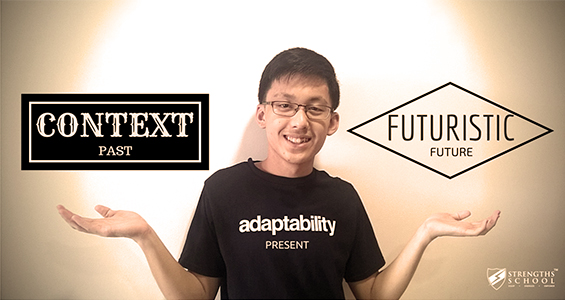
While everyone has a unique combination of strengths in their top 5 CliftonStrengths themes, some combinations come across to me as intriguing and interesting. Singaporean Student, Yu Fung, had a pretty interesting combination of CliftonStrengths themes. This combination caught my eyes because his themes have a time-based characteristic tied to them. Yu Fung has Context, Adaptability and Futuristic in his top 5 CliftonStrengths results. A person with Context enjoys looking into the past to make sense of the future. A person with Adaptability prefer to be in the present and enjoys the "now". A person with Futuristic likes to dream about possibilities that can happen in the future. This was the first time I came across such a unique and interesting combination since I started Strengths-Based coaching in Singapore. To top it up, Yu Fung also had Connectedness in his top 5 CliftonStrengths results.
I had the privilege to interview Yu Fung to understand a little bit more about how he naturally think, feel and behave. The interview is detailed below.
1) Could you share with us the sequence of how you go about making decisions having all 3 talent themes (Context, Adaptability & Futuristic)? If you can, provide an example so that readers can understand.
YF: I tend to find myself making decisions by first thinking of what has already occurred in the past, using "Context" to filter the answers to my question out. Following that, I will think of ways to "repeat" those occurrences from the past in the coming future, using the "Futuristic" trait. After which, I then adjust my current situation and myself to get the desired result I want to see in the future, thus using "Adaptability", and all 3 themes to make decisions. An example of how I make decisions like this would be my goal of studying at Waseda University. Firstly, I did some research on what kind of graduates the University produced in the past. Through the research, I decided that it would be good if I can graduate from this same University in the future, as it had produced influential graduates in the past. After making this decision and having a goal in mind, I used this information to change my subject combination now in the Singapore Junior College that I'm studying at. I decide to change the subject combination to one that I feel will give me the best chance to enrol in that particular University in the future. This is how many of my decisions are made using these three different talent themes.
2) Is there a difference for the sequence when it comes to smaller decisions compared to bigger ones?
YF: Regarding the sequence of talents utilised during choices, I mostly tend to lean towards solely my Adaptability theme when there are quick decisions to be made and I have only a few minutes to make these decisions. I use all the three talent themes of Context, Adaptability and Futuristic mainly when there are large and key decisions.
3) Which talent theme do you resonate with the most and why?
YF: Personally I feel I resonate the most with the Context theme as I really enjoy digging up the past with all its mysteries. I feel the past has a lot of meaning and I enjoy reading about what others have done. I love studying my history subject in school!
4) You're the first person whom I have come across who has all 3 "time factored" talents. How do you feel about this combination?
YF: Haha. I think that these 3 talents I have are quite special in a way to me. Using them is almost second nature to me. Now knowing that I am so unique is really surprising to me. I always thought such thinking is normal. I feel great about this talent theme combination because I really enjoy using these 3 talent themes. It is who I am.
5) How are these 3 talent themes shown when it comes to your studies or school life?
YF: I feel that the Futuristic theme is the one theme I rarely use in school especially in Junior College. Maybe I just need more guidance on how to use this theme effectively. I feel that the Context theme is very much visible due to the plain fact that I take History as a subject. I really enjoy studying about the past. I use my Adaptability theme frequently in my studies as I tend to adjust my study schedules a lot. I enjoy studying in a very dynamic and spontaneous way.
6) Have you taken any leadership role before? If yes, how do you think you use these 3 talents for your leadership role?
YF: I was appointed the head of the Secondary One students in my previous Co-Curricular Activity (CCA) during my senior years in Secondary school. I had to use my Context theme to recreate programs or initiatives that I felt was personally impactful to me in the past, while adapting minor changes to make the planned programs more effective to the students I was leading. I think the fine tuning was the Adaptability theme at work. Of course, the programs are made because my Futuristic believes that the students can grow in the future as a direct or indirect result of the planned program.
7) Do you have any interests/ hobbies/ favourite movies covering 1, 2 or all 3 of the talents?
YF: I do not really have hobbies that cover the Futuristic talent theme, but I do have some for the other 2 themes of Context and Adaptability . I enjoy building scale model replicas of World War II battleships, and am currently still working on one. This is because I deeply enjoy the history of WW2. I also enjoy playing RTS (Real-Time Strategy) games, as they force me to think on my feet and make decisions as and when something happens, using my Adaptability theme.
8) When you think and reflect on your own life, how do these 3 talent themes affect your thought process?
YF: Whenever I reflect on my life, I feel that I tend to follow the ranking of the strengths I have tellingly. I will always start by thinking of what have I done before, then move on to what outcome I desire to accomplish in the future. After that, I will decide on what to do in the present. This is my natural thought process.
YF: Thank you for this interview. I learn a lot about myself as I reflect.
Concluding Thoughts: Some people have very interesting combinations of talent themes in their top 5 StrengthsFinder results. These combinations provide very unique perspectives that can become a great source of strength and power to help a person succeed in what he does.
If you know of someone who you feel has a very unique combination of talent themes, let me know! I'll love to conduct an interview with this person to find out more! Do watch out for part 2 of this StrengthsFinder Theme Combination Series. The next article will explore StrengthsFinder themes tied to the idea of speed.
READ: SPEED-BASED STRENGTHSFINDER THEME COMBINATION
Written by Victor Seet
Activator • Communication • Strategic • Self-Assurance • Command

Mother's Day Article 2018: The Strength of Mothers
When we think about genuine strength, the image of a mother is rarely far behind. Singapore CliftonStrengths coach Victor Seet shares a personal tribute to mothers - exploring the quiet, consistent strengths they embody every single day.

I often imagine how hard it must have been for my mum to bring me and my sister up when we were young. Now that I’m a parent, I find myself armed with a heightened awareness of just how different my imagination is from reality. Being a father to two children with a third on the way, I can now say that I appreciate my mum in a greater measure as I see up-close the challenges that my wife, Michelle, faces in the day-to-day routine of parenting.
As I think about the sacrifices that all mothers make, I am humbled by the kind of work Michelle does in her role as a mother. As I recall our journey from being a married couple with no children to becoming parents, I have seen how she has grown from a wife to becoming a wife and a mother.
5 years into our marriage, we had our first child. We had our second 2 years later and now our third child is about to be born. The transition from being a wife to becoming a mother has been challenging to say the very least.
“As I think about the sacrifices that all mothers make, I am humbled by the kind of work Michelle does in her role as a mother.”
We had a discussion about Michelle’s career and spoke at length about how she would manage working a full-time job with the challenging demands of being a mother to 2 young boys. In the end, we decided to try out several different options. Michelle took a year’s absence from full-time work and later filled a part-time role first before returning to teaching full-time. Trying out these different options brought about many challenges and disruptions that required much adjustments to made. I’m very appreciative of the sacrifices that Michelle has made for the family. I will never take for granted the fact that Michelle’s career progression and ambitions have been affected because of these sacrifices that she has made and I am very grateful.
I know that the experience of carrying a baby for 40 weeks in the womb is, for Michelle, not a comfortable one. To repeat that process three times is something I can only deeply respect. As a guy, I will never experience pregnancy but I imagine it to be similar to doing an Army Training Evaluation Centre (ATEC) evaluation in National Service (for 40 continuous weeks). The mental, physical and emotional energy needed is probably the most comparable in my lousy imagination. How someone can repeat this process 3 times is beyond me. In Michelle’s words, the simple action of lying flat down your tummy after giving birth is akin to tasting heaven. I can identify with that simple joy. To us guys, a similar joy would be to take a shower after an intense week of ATEC outfield exercises. It is so easy to take the small things for granted but my wife has taught me to cherish much.
“As a guy, I will never experience pregnancy but I imagine it to be similar to doing an Army Training Evaluation Centre (ATEC) evaluation in NS (for 40 continuous weeks).”
When I see what Michelle does on a regular basis and the amount of energy she expends to carry out all the tasks, it makes army life suddenly looks somewhat manageable. Her daily routine starts at 6am with preparation for the boys to be ready for school and the adults to be ready to work. By 12 midnight, after a full day’s work in school and at home, the wife will collapse onto the bed. The tasks of doing the never-ending laundry, ironing, putting the clothes back into the wardrobe, preparing the children’s cereals and porridge, mopping the floor and doing the dishes may seem ordinary to some but not to me. The intensity of these tasks have made the transition from wife to mother physically challenging. Looking back, I think that our capable parents probably sheltered us from much of this hard work, making our adjustment to the daily riguor of such parenting routines tough and often discouraging.
Apart from juggling the household chores to her daily work as a teacher, my wife, Michelle, now juggles the additional daily routine of looking after the boys. This to me is execution power at its highest level. There is an insane amount of detail one needs to be concerned about – from remembering to stock up on groceries and regular household items, to remembering the kinds of medicine the children need to take and the dosage, to all the different childcare details etc. I’m so glad that someone like me who is not a naturally detail-oriented person has someone like Michelle to share this burden with.
Michelle will always claims that “mother’s instinct” is a fallacy and I can understand where she comes from. I observe a huge amount of discipline that Michelle undertakes to make sure things get done and responsibilities are taken care of. She works really hard. I’m so glad that I married a wife who has Responsibility, Achiever and Discipline as her strengths!
“If God’s desire is to make us holy rather than happy, I can truly say with certainty that parenting is a divine work.”
Reflecting on the work my wife puts in for our family has made me think hard about the idea of Godly work. If God’s desire is to make us holy rather than happy, I can truly say with certainty that parenting is a divine work. Becoming parents is a path that Michelle and I made together by choice. I see it as a similar path to the one Jesus took when he carried the cross to Calvary – a path filled with pain and suffering but one that signifies obedience. This path is not one taken out of convenience but of conviction. Walking this path has led Michelle to seek God more in her times of need, reflect on her own character flaws and allowed God to continue to mold and shape her. If there is one aspect that I want to specially pay tribute to, it will be my wife’s resolve to please God in the holy work of parenting. I think that is a strength Michelle has truly exhibited. I am glad to have experienced my wife’s walk with God first-hand.
I now have a deeper sense of how motherhood is a high and divine calling, one that is holy work and certainly not lesser than other kinds of work. I pray that God's blessings and grace continue to be given to all the mothers out there. Happy Mother’s Day!
*This article was first written as a guest article for Church of Our Saviour Singapore, published under the title of "The Holy Work of Mothers". This version has been slightly edited and re-published.

What's in a Teacher?
What do great teachers in Singapore have in common, at least in terms of their natural talents? Singapore Gallup Certified Coach Victor Seet shares his research findings on the most frequently occurring CliftonStrengths themes among educators, and what they mean in practice.

I have always admired what teachers do. I married a teacher, and I have so many good friends who chose this vocation.
As a Gallup certified coach in Singapore, I also have the added privilege of working with many school leaders and teachers, conducting Strengths-based Leadership Workshops for teachers and partnering with them in conducting Strengths-based student development programs.
Being a teacher is a high calling. To many Singaporeans, the profession entails imparting knowledge and developing the students’ potential.
But to me, it’s so much more than that.
The long hours, the intense marking of scripts, the pressure of managing a group of vastly different (and easily distracted) students every day, and the increasing administrative workloads make this vocation an extremely challenging one.
In fact, many teachers suffer burn-out because of the intense day-to-day demands. I’ve often heard first-hand the challenges faced by teachers, and I’ve grown to develop much respect for these teachers.
As we celebrate Teachers’ Day this week, I’m asking myself this question: “What’s in a teacher? What kind of strengths do teachers in Singapore have?”
Driven by that question, I took some time to compile data on different teachers in Singapore. I’ve coached almost all of them or conducted Strengths-based Leadership Workshops for.
In this analysis, I look into a sample size of 1,200 teachers spanning 30 different Singaporean government schools, including primary, secondary, and junior colleges.
What were my findings?
Amongst all the teachers I’ve worked with, the Responsibility talent theme is the most common. Out of the sample size of 1,200, 39% of them had the Responsibility theme in their Top 5 profiles.
The second most common strength is the Learner theme, coming in at 33%.
From there, Relator, Connectedness, and Harmony are the next most common themes (in that order). These three StrengthsFinder themes are found amongst 26-27% of the teacher population. (The difference in percentages was so small as to be negligible, although a larger sample size might reveal a greater disparity.)
On the other end of the spectrum, the rarest strength amongst Singaporean teachers is the Competition StrengthsFinder theme. Only 1% of the teachers in the sample had this theme.
The second rarest strength is the Significance StrengthsFinder theme, coming in at 2%.
What does this data tell us about teachers in Singapore?
1. Singaporean teachers are dedicated and committed.
This is evident from the Responsibility theme. This finding comes as no surprise, given what I’ve observed on a regular basis.
The high sense of ownership drives many teachers to have a deep dedication to their work. Pushing hard (often to the point of working on weekends) is incredibly normal to many teachers. The dedication to impact students often means going the extra mile too.
Married to a teacher wife whose number 1 strength is Responsibility, I often observe how this deep sense of dedication plays out. I have seen many times how she went beyond her duty to help her students with other aspects of their lives (beyond the academic portion). I imagined that many teachers are doing the same. There are so many stories I have heard from friends recounting how different teachers have impacted their lives. With my Responsibility strength ranked at number 22, I'm amazed at how powerful the deep sense of psychological ownership can be.
I think we should all celebrate the fact that as a nation, Singapore is full of dedicated teachers!
READ: USING STRENGTHSFINDER AS A TEACHER
2. Singaporean teachers embody lifelong learning.
When we talk about Singapore’s vision to cultivate a “Learning Nation,” these are people who truly walk the talk. This comes from the strong Learner theme within the demographic.
I am also mindful that the unique wiring of those with the Learner theme gives them the inclination to pursue this calling as a teacher. Many Learners enjoy the process of learning and they desire to impart their knowledge and skills to others as well.
I learnt a lot about Learners by observing my wife in action. Her motivation to make sure our kids pick up knowledge and skill sets from a very young age sets her apart from me (I'm quite low on the Learner theme). She spends quite a bit of time learning about how she can create better activities for the kids to learn more effectively, as well as creating platforms for the kids to pick up new knowledge and skills. This is in stark contrast to me – I do enjoy learning, but am often not very intentional about it. With the combination of Responsibility and Learner as her top 2 strengths, I’m thankful and assured that the teachers in our nation take extremely high ownership of their own learning and those of the kids.
I can safely conclude that the MOE mission of cultivating lifelong learners is a corporate mission that resonates deeply with our teachers. With Learner as one of their top themes, it’s more of an intrinsic desire than a job that needs to be done. Thank God that we have so many educators who have the Learner theme!
3. Singaporean teachers build deep lasting relationships.
This is a result of having such a large group of teachers possess the Relator theme.
Relators are those who build deep and lasting relationships. In a world where we are experiencing increasing number of broken families, some of the deep friendships that the teachers have forged with their students will make a huge lasting impact. I believe many of the Singapore teachers will look back and realized the trust and belief they give to their students will empower them to choose the right path.
Relators also value authenticity. This finding tells me that in the development of students, teachers will inevitably challenge and teach students to embrace the full measure of their own unique identities rather than trying to make them be like someone else.
With the growing increase of a narrative telling young people to pursue a quick shot at stardom, this trait is especially important, in my opinion. We, as a nation, need teachers who can help young people combat the lure of trying to be like their idols. We need teachers who can model authenticity to young people. Relators have that gift.
4. Singaporean teachers see the bigger picture behind their individual work.
There is a greater purpose and meaning to this vocation. This comes from the Connectedness theme. Teachers are not merely raising the quality of students. They are building a nation. They are equipping the future generations of Singapore.
It’s said that it takes a village to raise a child. The teachers with Connectedness probably understand the depth of such a phrase. There is now more and more emphasis on collaborative work with different stakeholders to help strengthen the development of our youth. There are more parent dialogue sessions. There are more internship arrangements with companies and different industry partners.
I am very encouraged to find so many school leaders and teachers who are willing to partner with us to impact the lives of the students. Rather than simply seeing us as vendors providing a service, many teachers view us as partners who also contribute to the work of building up our future generations.
It is heartening to see so many teachers with this theme. We need teachers who are gifted in connecting the dots. Rather than seeing education as a pursuit of paper qualifications, this finding tells me that our teachers are driven to help young people understand the impact of education on the different areas of their lives! That is worth giving thanks for!
5. Singaporean teachers embrace the collaborative narrative.
This comes from the Harmony theme. People with Harmony enjoy collaborative work. Rather than tearing ideas down, they seek to find alignment and consensus within the different voices.
In a world dominated by "I," "me," and "mine," it is so important that our future generations have teachers who can emphasize the "we" and "us" and what it means to work closely with others.
It is said that the increase of technology usage and social media has a direct impact in lowering the level of social skills of our future generations. I am glad to find that so many of our teachers are hard wired to seek for consensus and collaboration. This tells me that it will be natural for many teachers to teach and model teamwork and community building for the students. That will be such an important aspect moving forward. Our teachers are armed with the strength to counter the individualistic culture through the Harmony theme.
Other than building a collaborative narrative, people with Harmony are also people who desire to bring peace. In a world where racism is still a norm in many nations, we need teachers who can help the young cultivate a sense of respect for people regardless of race, language or religion. The lack of racial harmony has wrecked many nations. I’m thankful that a large group of our Singapore teachers intrinsically value peace and collaboration.
Concluding thoughts: After highlighting the 5 most common strengths found among our teachers, I discovered something interesting about the other spectrum. While there is a sizeable number of Singaporeans with the Competition StrengthsFinder theme, only 1% of our teachers have this theme.
This tells me that the teachers in Singapore are not likely to be obsessed with benchmarking. While the current system puts a certain pressure on students to go all out in pursuing stellar academic results, our Singaporean teachers might not enjoy such a system. There has been a gradual shift in the focus by MOE to move away from giving too much emphasis to the academic successes of our students. I’m guessing many of our teachers are quietly smiling in their hearts.
What are your thoughts?
Do you resonate with the findings? I'd be happy to hear your thoughts!
Regardless, join me in thanking all the teachers in Singapore for their dedication and passion to invest in the young and helping them to be "Future-Ready!"

Worship In Our Workplace: 7 Practical Ways
Is your worship being limited to praying and singing hymns and songs in church? How does one worship God in the workplace? Victor shares seven practical ways that he has been working on.

As a former full time church worker, I used to lead worship in my church as well as oversee the Youth Ministry Worship team from Church of Our Saviour, Singapore. Worship is a topic that I have always been very interested in. When I speak to different Christians on what worship is, I get a variety of responses. There are different perceptions on what worship is about.
My Senior Pastor, Daniel Wee, once spoke about what true worship is: an act of love, a burnt offering, something we give because we love God and we can anticipate His pleasure. That resonated with me.
As an entrepreneur and professional coach, I desire to take this idea of worship deep into the work I do. Often, I think about how I can listen to my clients without judgment. I think about how to hold space for them to share safely and openly. I think about how I can engage in difficult conversations with gentleness, courage and compassion. Whenever I run the CliftonStrengths (formerly StrengthsFinder) workshops for clients, I think about how to be a blessing to each participant. In short, I am constantly thinking about how I express my worship to God through my work.
I am writing this article to share my thoughts and reflections on how I have taken this idea of worship into my my work as an executive and team coach through simple and practical ways.
The bible tells us to love God with all our heart, soul and mind. We are also called to love our neighbour as we love ourselves. One of the most straightforward ideas of worship lies in loving our neighbour - being that good Samaritan to the wounded man. We can anticipate that God will be glorified and delighted when we give our best to love our neighbours at work.
So, how can we worship God through loving our neighbour in our workplace?
1. Intentionally create space to relate
Because our God is a relational God, our worship must therefore be reflected in an active lifestyle of loving our neighbours. Many Christians are content to accept the idea of worship as mainly to give our best piece of “work” to God. This perspective must be challenged.
As Christians, we must be intentional in loving others. Especially in Singapore, where busyness is the norm, it is often challenging to create space to love. For me, loving means being intentional to listen to others. It is creating a capacity in our hearts to listen to others’ needs. It is carving out time for others. It is finding ways to reduce the end-to-end busyness so that we can have time to attend to others, to help when there is a need. Most Christians do not find it hard to help others when they have time to spare. It is when they are so packed with activities (this includes ministry activities) that they end up neglecting real needs.
Often, fulfilling experiences can come out of simple but deep conversations with a fellow colleague. My wife, Michelle, recently shared with me a delightful experience she had. It was her simply having a deep conversation on a bus ride home with her colleague. One of the most enjoyable things at work for me was to make time to connect with different coaches on a 1 on 1 basis. Coaches also need support and I intentionally choose to be a support to other coaches as well as therapists.
2. Show Grace when it is least expected
Grace is extravagant. Grace is the idea of the Father eagerly waiting for the prodigal son to return home and to give him the best when the son least expects it. Grace is that gift when a person least expects one.
Interestingly, I have noticed that people seem to remember the moments when someone at work goes the extra mile to help with a kind deed. That is love in action. That is extending grace; going beyond what is expected, beyond the “this is my job” mentality. Over the years, I've lost count of the times my colleagues showed me what practical grace is about.
When we are upset and feel like doing something that resembles a tit for tat, pause and take a deep breath. Another way to show grace is to respond in the opposite spirit. Respond in love and kindness. Do something in love for that person who might not deserve it.
I'm thankful that I am often reminded to extend grace because of how others have treated me.
3. Pray for our co-workers
There is no better Kingdom-minded way of worshiping God in our workplace than by infusing prayer into every part of our work.
Praying for a client, a co-worker at the right moment when we sense that something is weighing on their hearts is a powerful way of obeying the Spirit’s prompting. One of the ways of being led by the Spirit is to be mindful of the opportunity to minister to others through prayer.
Needless to say, we need to first ask for permission to pray for the individual. The person might respond with a simple “yes and thank you”. Our response is to pray and believe the work of love is done in the heart of the person by the Holy Spirit. If the individual rejects us when we ask for permission to pray, (in my experience, that almost never happens), that gesture shown is already an act of love.
4. Encourage others with kind words
“Pleasant words are a honeycomb, Sweet to the soul and healing to the bones.” Proverbs 16:24
Many may consider that speaking kind words might seem more of a Western than an Asian concept. But, the Bible does encourage us to do more of that.
A practical action would be to catch someone doing something right and to specifically give encouraging words that highlight the right action. Rather than a generic “good job”, be specific and describe the action or attitude. For example, “I saw you restraining yourself when the easier way was to lash out. I thought that was a fantastic response!”
Learning to catch someone doing good is learning to be observant of Christ-like behavior.
5. Help those in trouble
“The LORD also will be a stronghold for the oppressed, A stronghold in times of trouble” Psalm 9:9
Bullying happens frequently at the workplace. How are we responding to bullying in the workplace?
While the answer might not often be straightforward, the one thing we can do is to show concern for those who feel marginalized. Be a listening ear; pray with this person and ask God to replace negative emotions with His compassion. We can also stand up for the injustice when the Holy Spirit prompts us.
6. Honor your leaders
Most of us might take issue with these 3 types of leaders we perceive:
Incompetent leaders
Uncaring leaders
Dishonest leaders
While our perceptions might not reflect the truth, they affect our attitudes and our responses.
Honoring the incompetent leader means employing a Christ-like attitude to serve them as followers. Find ways to build them up rather than tear them down. Think about what they are good at rather than what they are bad at. Play to our leaders’ strengths. Eventually, we reap what we sow when we become leaders ourselves. Followership is just as important as leadership. Our ability to follow reflects our heart attitude.
Honoring the uncaring leader means we respond in kindness and compassion. Rather than complaining about their lack of love and care, we initiate and show kindness to these leaders through small acts of love, encouraging words and prayer.
Honoring the dishonest leader does not mean agreeing with malpractice. Honoring means giving value to the person rather than the behavior. This means that we learn to see with the eyes of compassion and believe that God will be the merciful judge. We pray for wisdom to find ways to influence. We pray for courage to reject any dishonest dealings. We pray for restraint from bad mouthing our leader and try our best not to speak ill of a person whom Jesus passionately loves.
7. Practice forgiveness
Forgiveness is a matter of the heart. Many of us find it difficult to apologize and say sorry. It is often even harder to release forgiveness to those who have hurt us. True worship teaches us that the surrendering of our hearts is pleasing to God. Releasing forgiveness to a person is saying to God that we surrender to His sovereign plans and we believe in His amazing grace. Forgiveness is a powerful act of obedience to God.
We can worship God by practicing forgiveness and keeping short accounts. Forgiveness teaches us about the condition of our hearts and reveals our ability to render God as King.
In conclusion…
These points have come about about from my own struggles in practising the concept of worship at work. I have learnt over the years is that true worship is really about being a living sacrifice. God does not expect us to be perfect. He sees our struggles and He receives our burnt offerings.
*All scripture quotations have been taken from the New American Standard Bible (NASB).

Overcoming the Deficit
Have you met people who seem to always talk about what they lack rather than what they have? Are you one of those who might even be guilty of this? As a Christian, Victor Seet shares his personal thoughts about how the deficit mentality seems to be robbing many from receiving God's grace and how this can be overcome

My 5-year-old son, Lucas often asks me: “Why does 弟弟 (younger brother) have this [toy] but I don’t?” This recurring question caught my attention recently because I could relate it to many similar experiences at work. In my job as a professional trainer helping people discover and apply their strengths, I have often experienced this particular mindset that seems to exist among many who have attended the Gallup StrengthsFinder workshops that I conduct, both in Singapore and also around the Asia region. This mentality expresses itself most naturally by focusing on what we do not have rather than what we have.
I define this as a ‘deficit thinking mentality’.
The ‘deficit thinking mentality’ causes many to be in discontent. I find it interesting, whenever I run training workshops, to observe the different behaviours of my participants and the types of questions that they pose. Those with a ‘deficit’ mindset will more likely than not complain about their lack of strengths and some may even reject their own strengths as they compare themselves with the strengths of others.
Rather than focusing on what strengths they already have and how they can apply them, many choose instead to focus their thoughts on what they do not have, therefore empowering the fear of lack. I have observed that this ‘deficit thinking mentality’ appears to span across both genders, age groups, and even tiers of leadership positions.
In my preparation for 2017, I found myself wondering about the extent to which @@the ‘deficit thinking mentality’ has stopped us from living the abundant life that Jesus has given@@. It is probably reasonable to suggest that there are many Christians who empower this mindset and struggle with the fear of lack as a result. I, for one, am guilty of allowing this fear to manifest in different areas of my life.
I believe that the ‘deficit thinking mentality’ is robbing many (myself included) from experiencing God’s abundant grace and providence in our lives. The Bible talks a lot about this idea of lack, and many passages reveal that it is common for people to struggle with this mindset. One of the earliest passages that clearly highlights this human condition can be found in Exodus 16.
Exodus 16:15-20
When the sons of Israel saw it, they said to one another, “What is it?” For they did not know what it was. And Moses said to them, “It is the bread which the LORD has given you to eat. This is what the LORD has commanded, ‘Gather of it every man as much as he should eat; you shall take an omer apiece according to the number of persons each of you has in his tent.’” The sons of Israel did so, and some gathered much and some little. When they measured it with an omer, he who had gathered much had no excess, and he who had gathered little had no lack; every man gathered as much as he should eat. Moses said to them, “Let no man leave any of it until morning.” But they did not listen to Moses, and some left part of it until morning, and it bred worms and became foul; and Moses was angry with them.
The passage clearly shows that many Israelites had a fear of lack and gathered more food than they needed. Where did this fear come from? This question is not easy to answer. What seems clearer to me is: since the early days of biblical history, we humans have struggled with this fear of lack and the ‘deficit thinking mentality’. If we desire to delete the deficit thinking in both our hearts and minds, and trust in God wholeheartedly, then a good question to ponder on is:
“@@How have I manifested the fear of lack in my own life?@@”
As we enter into 2017, wondering about the plans that God may have in store for us for the rest of this year, may I suggest that we start first by giving thanks for all that God has given us - both big and small. I believe that the simple yet powerful solution to counter this fear of lack is in the practice of giving thanks.
1 Thessalonians 5:18 says, “in everything give thanks; for this is God’s will for you in Christ Jesus.”
It might be helpful to set aside time to list down all the different things we want to give thanks for. As we do this, we are also intentionally creating capacity in our hearts to draw us back to the heart of our generous Father in Heaven who gives to His children beyond measure. The practice of giving thanks also prepares our hearts for the right posture to put our faith in God as our Provider. Naturally, this process helps us to combat the ‘deficit thinking mentality’ and the natural outcome is often a heart that will also create space to appreciate others.
As we count our blessings, we develop a faith that looks forward with a hope and a future.
How much are you looking forward to 2017? The answer to this question will likely correlate with how much you have been thankful for in 2016. If you haven’t done so already, start preparing for the rest of 2017 by writing down a whole list of things you can give thanks to God for today!
Wishing everyone a blessed year ahead!
This article was first published on the COOS website.

People Engagement in Churches: Making a Positive Connection
Are you one of those who wondered why many Christians seem to be feeling disengaged in church, especially among young people? Victor Seet shares some insights and also some practical steps people can do to increase the level of engagement.

*This article was first published on the Church of Our Saviour blog on October 2016.
During my time as a full-time Youth Pastor in Church of Our Saviour Singapore, I sought primarily to help young people shape their inner lives the way I felt mine was shaped – by focusing on what we thought was wrong with human beings. To me, it was about knowing the sinful nature of man and learning to lean on God’s grace and mercy. I have many stories about my own insecurities and fears, and how God has transformed my life.
I have come to realize now, that focusing on the ‘bad’ is not just inadequate but seems to have a detrimental effect especially when engaging people for the purpose of discipleship.
Many of us (myself included) are often quick to point out the shortcomings of others and then offer solutions (inner healing, counseling, etc.) to overcome them. When we do this, we fall short of empowering people to use their gifts and talents. We may be skilled at explaining the sinful nature of man but what about describing what a victorious Christian life should look like? As a leader, I have discovered that revealing the truth about our human weakness is definitely necessary but to focus on those weaknesses is hardly the encouragement that one needs.
An article in the Business Times on 01 August 2016 highlighted that more than half of Singapore companies have experienced staff who are physically present but mentally absent. According to the research, this phenomenon, termed “inner resignation” has been observed in 57 per cent of Singapore businesses.
Employee Engagement is a key issue in society today. It seems that in church, it is no different. It is not a wild idea to suggest that only a small proportion of church members feel engaged.
In my personal observation, our obsession with human weakness has hindered us in engaging and discipling people in the workforce as well as in church. Similarly in biological families, an increasing number of young people feel the disconnect at home because parents repeatedly only highlight what is wrong. Affirmations and encouragements appear to be a rarity.
Here’s another alarming fact. The World Health Organization has indicated that by 2020, depression will be the number 1 disease with the greatest negative impact on the global community. We are well on the way because depression currently sits at number 2 and by 2020, many of our young people will become adults.
There is a growing realization that in order to know how to overcome depression, we must study people who live meaningful, fulfilled and happy lives. Understanding the factors that are needed to help people stay positive has prompted the development of a branch of psychology known as “positive psychology”.
So, what if we focus on what’s right with people?
In the beginning of this year, I realized that I have spent the last 10 years focused on looking at the ‘wrong’ in people. I decided that I needed to realign my focus on what is right instead and I’ve since left ministry to set up my own company. I now help others discover their strengths through programs on employee engagement and student development using a tool called CliftonStrengths (formerly known as Gallup StrengthsFinder).
I pray that a paradigm shift takes place in our mindsets because I strongly believe that helping people discover what’s right with them is just as important as discovering what’s wrong. Looking at what’s right is critical in learning how to live a victorious life.
With this new outlook, how can we journey forward together especially as a church community?
1. Focusing on strengths
In 1 Corinthians 12, Paul describes the body of Christ, how we are all made uniquely and how we need one another to function to capacity. Each one of us is empowered with God-given talents and gifts to make a difference and be the salt and light in our community.
By focusing on our strengths, we start to respect the strengths that different individuals have so that we can go deeper in living out the concept of the body of Christ. In this way, we can build a culture of honour within the body of Christ. By learning to appreciate our unique talents, we can serve one another and even respectfully admonish and give constructive feedback. We earn that right to speak because people know what they are appreciated for. By focusing on our strengths, we catch people doing good as opposed to only catching people doing wrong.
“A leader needs to know his strengths as a carpenter knows his tools, or a physician knows the instruments at her disposal. What great leaders have in common is that each truly knows his or her strengths – and call on the right strength at the right time.” – the late Donald Clifton, author of Strengths-based Leadership.
2. Cultivate an attitude of gratefulness
The bible commands us to give thanks to God. Giving thanks changes our inner attitudes and helps us to be positive and hopeful in Christ. In a society where there is so much malice, bitterness and anger, cultivating a thankful heart helps us to appreciate one another. It also allows us to love and to receive love.
Try this exercise of giving thanks, 15 minutes a week. Do this with your family, do this with your friends. Do this for 10 consecutive weeks and observe the effects.
Questions for self-reflection:
From a scale of 0-10, how aware are you of your own strengths?
Reflect and think about how you are using your strengths for each of these areas: marriage, family, work, ministry.
How can you be more intentional in cultivating a thankful heart?
Written by Victor Seet